
Spanish economy 2026: what UK property buyers should watch
Spanish economy 2026 in short: GDP grew 2.7 per cent on the year in the third quarter on INE's flash estimate, against 1.4 per cent for the UK in the second. Unemployment is more than double the UK's, though, and inflation is 4.9 per cent. For property buyers, interest rates, sterling and the 29 November election matter most.
How is the Spanish economy doing in 2026?
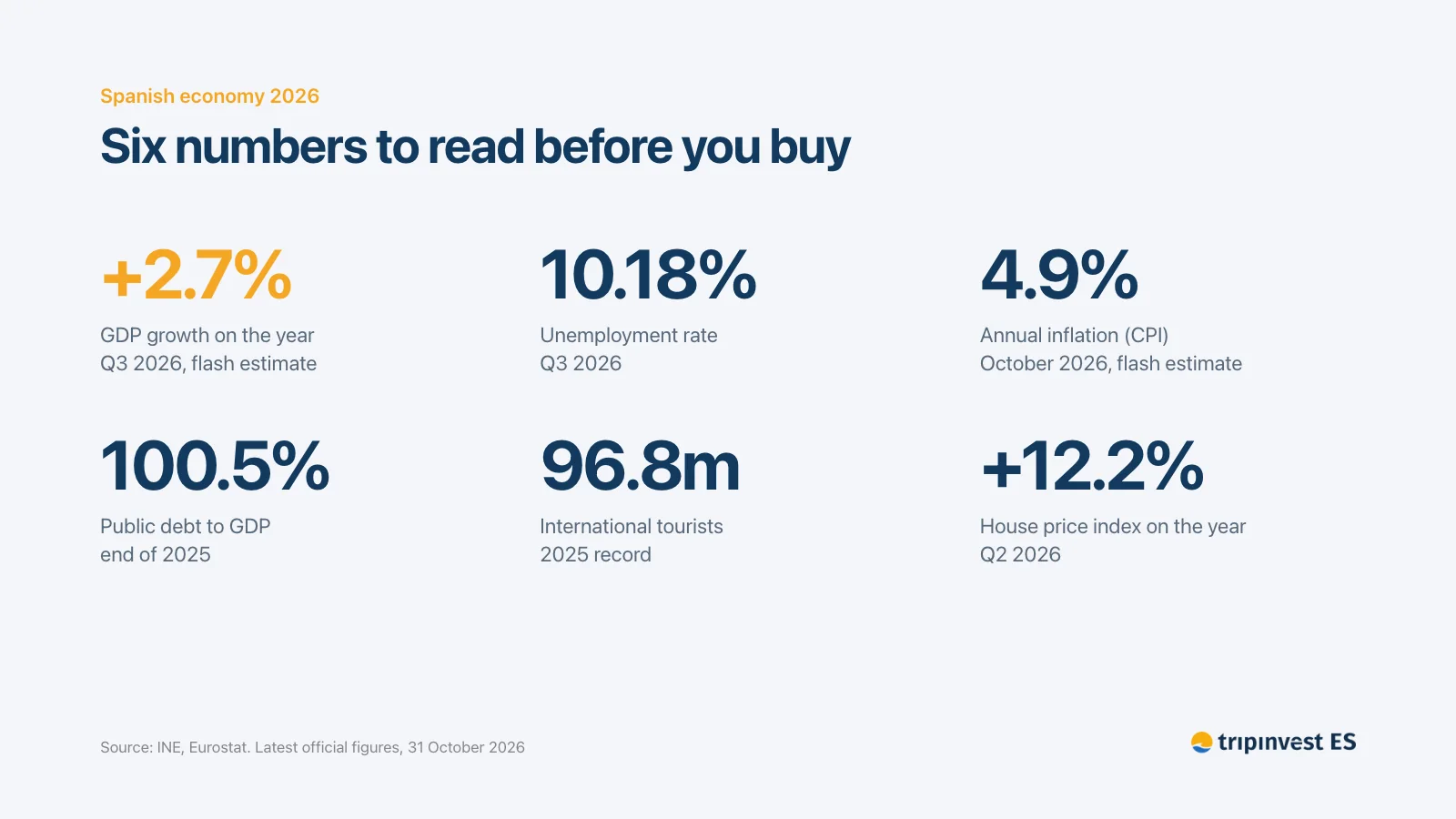
Well on growth, less well on prices. INE, Spain's statistics office, put GDP up 2.7 per cent on the year in the third quarter of 2026, and up 0.6 per cent on the previous quarter. That is a flash estimate, published on 30 October. The second quarter was 2.6 per cent on the year.
Spain has a strong run behind it. GDP grew 6.7 per cent in 2021, 6.4 per cent in 2022, 2.4 per cent in 2023, 3.7 per cent in 2024 and 2.6 per cent in 2025, according to Eurostat. That beat the euro area average in every one of those years. In 2025 the euro area managed 1.2 per cent.
Jobs have followed. Spain had 22.85 million people in work in the third quarter of 2026, up 465,500 on the year. The unemployment rate was 10.18 per cent, up 0.31 points on the quarter. The number of unemployed people was still 21,900 lower than a year earlier.
In May, the European Commission forecast growth of 2.4 per cent for 2026 and 1.9 per cent for 2027. The IMF's current figures are 2.5 and 1.8 per cent, against 1.3 and 1.2 per cent for the UK. That is a slower pace for Spain, but still the faster of the two.
Spanish economy vs UK: how do they compare?
Spain wins on growth and on the budget deficit. The UK wins on jobs, on income per head and, for now, on inflation. Here are the latest figures side by side.
| Measure | Spain | UK | Period |
|---|---|---|---|
| GDP growth on the year | 2.6 per cent | 1.4 per cent | Q2 2026 |
| GDP growth, full year | 2.6 per cent | 1.2 per cent | 2025 |
| Unemployment rate | 10.18 per cent | 4.7 per cent | Spain Q3, UK June to August 2026 |
| Annual inflation (CPI) | 4.9 per cent | 3.5 per cent | September 2026 |
| Central bank rate | 2.50 per cent | 3.75 per cent | October 2026 |
| Government debt, share of GDP | 100.5 per cent | 102.1 per cent | 2025 |
| Budget deficit, share of GDP | 2.4 per cent | 5.3 per cent | 2025 |
| GDP per head, adjusted for prices | $57,282 | $65,758 | 2025 |
| Size of the economy | $1.91 trillion | $4.01 trillion | 2025 |
The debt, deficit, income and size rows use IMF figures, so both countries are measured the same way. Spain's third quarter flash is not in the table because the UK has not yet published that quarter. On the EU's harmonised measure, Spanish inflation was 5.0 per cent in September. The UK headline you see in the news, public sector net debt, is a different measure: 94.0 per cent of GDP in September 2026.
The debt line is the surprise. Spain's debt was 119.3 per cent of GDP in 2020, and it has fallen every year since. The UK's has gone the other way since 2023, so Spain now sits slightly below it. The Commission expects Spanish debt to dip under 100 per cent in 2026.
Why is Spain's economy doing so well?
Three things stand out: more people, more tourists and stronger household finances.
People. Spain had a record 49.8 million residents on 1 July 2026, up about 444,000 in a year. Growth came from people born abroad, who now number 10.3 million. The Commission says immigration is supporting both spending and job creation.
Tourism. INE counted 71.7 million international tourists in 2022, 85.2 million in 2023 and a record 96.8 million in 2025. They spent €134.7 billion in 2025, and British visitors alone spent €23.65 billion. Tourism made up 12.6 per cent of GDP and 12.3 per cent of jobs in 2024. This year is still growing: 70.4 million arrivals from January to August, up 5.4 per cent, with 13.9 million from the UK.
Household and business finances. The Commission points to record-low household debt and healthy company finances, and expects EU recovery money to support investment, particularly in construction. On INE's third quarter flash, household spending rose 3.1 per cent on the year and investment 2.1 per cent.

What is wrong with Spain's economy?
Spain has real weak spots, and a buyer should know them.
- Inflation jumped. The CPI reached 4.9 per cent in September 2026, the highest since February 2023, and INE's flash for October is also 4.9 per cent. Fuel and package holidays drove the September rise. Core inflation was 3.1 per cent, but you still feel it at the till. On 29 October the ECB warned that the energy shock is likely to push euro area inflation up and growth down. Spain was below the euro area average in 2022 and 2023, then above it in 2024 and 2025.
- Unemployment is high. At 10.18 per cent it is more than double the UK rate. For under-25s it was 23.33 per cent in the third quarter of 2026.
- Regional gaps. Unemployment ran from 4.63 per cent in the Balearics to 14.91 per cent in Andalusia.
- Growth leans on Spain itself. Home demand supplied 2.6 points of the 2.7 per cent annual growth in the third quarter, and trade added almost nothing. The Commission also flags tourism as a risk, especially long-haul travel.
- Support is ending. EU recovery funds wind down, and the Commission expects tighter public spending in 2027.
- An election is close. Parliament was dissolved on 6 October and Spain votes on 29 November 2026.
Does the Costa Blanca follow the national economy?
Only partly. Spain has 17 autonomous communities with real powers of their own, so the national average hides a lot. Regional taxes differ too. Before you buy, look at the region as well as the country.
The Costa Blanca sits in Alicante province, in the Comunitat Valenciana. Here is how that region compares.
| Measure | Comunitat Valenciana | Spain | Period |
|---|---|---|---|
| Unemployment rate | 11.82 per cent | 10.18 per cent | Q3 2026 |
| GDP per head | €28,675 | €34,237 | 2025 |
| GDP growth | 2.3 per cent | 2.6 per cent | 2025 |
| Pay per employee, including employer costs | €37,660 | €40,514 | 2024 |
| International tourists, change on the year | up 9.0 per cent | up 5.4 per cent | January to August 2026 |
| House price index, change on the year | up 13.0 per cent | up 12.2 per cent | Q2 2026 |
So this is a poorer region than the national average, with a slightly higher jobless rate. Alicante province alone was at 11.73 per cent. Tourism is growing faster than in Spain as a whole, though, and 9.4 million international tourists came to the region from January to August. It also had the fastest population growth of any region in the second quarter.
Foreign buyers matter more here than anywhere else in Spain. They made 46.43 per cent of home purchases in Alicante province in the second quarter of 2026, the highest share of any province. Locals' wages are therefore only part of the story of who buys. Our guide to where to live in Spain and our Torrevieja property guide go further on individual towns.

What should UK property buyers watch?
These are the numbers we would keep an eye on.
| What to watch | Latest figure | Why it matters to you |
|---|---|---|
| ECB rate and Euribor | Deposit rate 2.50 per cent, 12-month Euribor 3.247 per cent in September | Feeds into the cost of a euro mortgage |
| Pound against the euro | £1 bought about €1.20 on 30 October 2026 | Sets your budget in pounds |
| Spanish inflation | 4.9 per cent in October, flash estimate | Affects day-to-day and running costs |
| Tourism arrivals | Up 5.4 per cent, January to August 2026 | Shapes local jobs and town life |
| Election | 29 November 2026 | May bring new rules for buyers |
| Home sales | 167,934 in Q2 2026, down about 2 per cent | Shows how busy the market is |
Interest rates. The ECB raised its deposit rate in June and again in September 2026, then held it at 2.50 per cent on 29 October. If you want a Spanish mortgage, check current offers, as our guide to mortgages for foreigners explains.
Sterling. The pound has helped British buyers lately. On 30 October 2025, a €250,000 home cost about £220,000 at the ECB rate. On 30 October 2026 it cost about £208,500. That gap of around £11,500 came from the exchange rate alone. It can reverse, so watch the rate before you commit. Irish buyers earn in euro and can skip this one.
The election. The proposed 100 per cent tax on non-EU, non-resident buyers is not law. The Local reported in October that it was never debated, and pending bills lapse when parliament is dissolved. What comes next depends on the new government. ITP on the Costa Blanca is set regionally. It has been 9 per cent on resale homes since 1 June 2026, or 11 per cent on the whole price if the home is worth more than €1 million. Total costs are up to 13 to 14 per cent on top of the listing price, as our guide to purchase costs shows.
House prices. On Eurostat's figures, Spain's house price index rose about 4.4 per cent a year on average from 2014 to 2023, then 8.5 per cent in 2024 and 12.7 per cent in 2025. INE's index was up 12.2 per cent on the year in the second quarter of 2026, and sales were lower. Past figures tell you what happened, not what happens next.
For more background, read our posts on whether Spain is a good market to invest in, Spanish property and inflation and the housing market statistics from early 2024. When you are ready to look at real homes, start with property for sale in Torrevieja.
Frequently asked questions
Is Spain's economy good right now?
On growth, yes. GDP rose 2.7 per cent on the year in the third quarter of 2026 on INE's flash estimate, and 465,500 more people were in work than a year earlier. The weaker points are inflation at 4.9 per cent and unemployment at 10.18 per cent, more than double the UK rate.
Is the Spanish economy growing faster than the UK's?
Yes. Spain grew 2.6 per cent on the year in the second quarter of 2026 against 1.4 per cent in the UK. For the whole of 2025, Spain managed 2.6 per cent and the UK 1.2 per cent. Spain also outgrew the UK in 2023 and 2024, on IMF figures.
Is Spain richer than the UK?
No. The IMF puts GDP per head in 2025, adjusted for prices, at about $57,300 in Spain and $65,800 in the UK. That leaves Spain roughly 13 per cent behind. Prices are lower in Spain, so the gap shrinks once you adjust for them, but it does not disappear.
Where does Spain's economy rank in Europe?
Spain was the fourth largest economy in the EU in 2025, behind Germany, France and Italy, with GDP of about €1.69 trillion according to Eurostat. The UK, outside the EU, is about twice the size. The IMF puts the two at $4.01 trillion and $1.91 trillion.
What is the biggest risk to the Spanish economy?
The clearest near-term risks are inflation, at 4.9 per cent in INE's October flash, and a slowdown in tourism, which the European Commission flags. Tourism made up 12.6 per cent of GDP in 2024, so a weak season matters. EU recovery funds are also ending, and that removes support for investment.
Will the November election change the rules for property buyers?
Spain votes on 29 November 2026, and the proposed 100 per cent tax on non-EU, non-resident buyers lapsed without ever becoming law. A new tax like it would need a fresh bill in the next parliament. ITP on the Costa Blanca is a regional tax, so this election does not set the 9 per cent rate.
Talk to us before you buy
Headline numbers help, but a decision comes down to one town, one street and one budget. Our agents have over 12 years' experience on the Spanish market, and Tripinvest ES has offices in Calpe and Torrevieja and a head office in London. We help you read the local market, we guide you from the first call to the notary, in English, and we keep an eye on deadlines. We work with lawyers and banks. We are a licensed agency, RAICV 4221. Our clients don't pay us commission.
Call us on +44 20 3888 0008 or send us a message.
Sources
Last checked: October 2026
Spain, official
- INE: quarterly national accounts flash, Q3 2026, published 30 October 2026
- INE: quarterly national accounts, Q2 2026, published 25 September 2026
- INE: labour force survey (EPA), Q3 2026, published 27 October 2026
- INE: EPA unemployment rates by age and region, Q3 2026
- INE: EPA unemployment rates by province, Q3 2026
- INE: consumer price index flash, October 2026, published 30 October 2026
- INE: consumer price index, September 2026, published 14 October 2026
- INE: Frontur international tourists, 2025, published 3 February 2026
- INE: Frontur international tourists, August 2026, published 2 October 2026
- INE: Egatur tourist spending, 2025
- INE: tourism satellite account, published 22 December 2025
- INE: population estimate, 1 July 2026, published 6 August 2026
- INE: regional GDP, 2023 to 2025, published 30 September 2026
- INE: regional accounts and pay per employee, 2024, published 16 December 2025
- INE: house price index, Q2 2026, published 7 September 2026
- BOE: Real Decreto 806/2026, dissolving parliament and calling the election
- BOE: Banco de España resolution with Euribor for September 2026
- BOE: Ley 13/1997, article 13, Valencian ITP rates
- BOE: Reglamento del Congreso, article 207, on pending business lapsing at dissolution
- Colegio de Registradores: Estadística Registral Inmobiliaria, Q2 2026
EU and international
- Eurostat: annual GDP growth, Spain and euro area
- Eurostat: GDP of EU economies, 2025
- Eurostat: government debt, Spain and euro area
- Eurostat: annual harmonised inflation, Spain and euro area
- Eurostat: annual house price index, Spain
- European Commission: economic forecast for Spain, 21 May 2026
- ECB: key interest rates
- ECB: monetary policy decision, 29 October 2026
- ECB: euro reference rates against sterling
- IMF DataMapper: real GDP growth and forecasts
- IMF DataMapper: general government gross debt
- IMF DataMapper: government net lending
- IMF DataMapper: GDP per head at purchasing power parity
- IMF DataMapper: GDP in US dollars
UK, official
- ONS: quarterly national accounts, Q2 2026, published 30 September 2026
- ONS: GDP growth on the year, series IHYR
- ONS: labour market overview, October 2026
- ONS: consumer price inflation, September 2026
- ONS: public sector finances, September 2026
- Bank of England: Bank Rate
Press