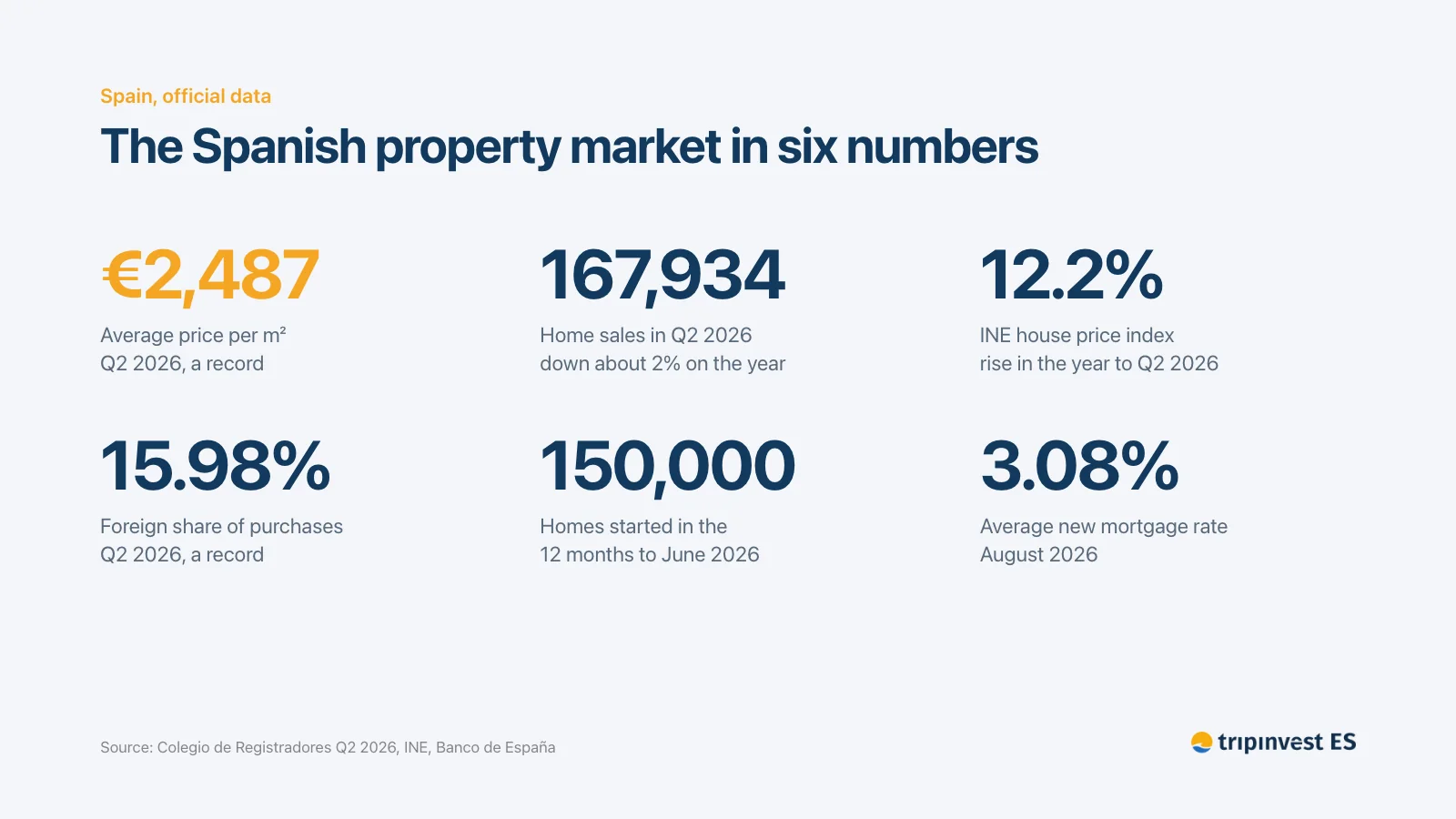
The Spanish property market in 2026 has record prices, softer sales and no official sign of a crash so far. Registered prices reached €2,487 per square metre in the second quarter, while sales fell about 2 per cent on the year to 167,934. Supply is thin and bad loans are low, but affordability is worsening.

This page reports what Spain's official statistics showed at the end of October 2026. It makes no forecast. We use the first quarter of 2024 as a yardstick because that is when Spain's house price index, as published by Eurostat, passed its 2007 peak.
How is the Spanish property market doing in 2026?
Prices are at a record, sales have eased for two quarters and foreign buyers hold a record share of purchases. The latest report from the Colegio de Registradores, Spain's land registrars, covers the second quarter of 2026.
| Spain, registered data | Q1 2024 | Q2 2026 |
|---|---|---|
| Average price per square metre | €1,998 | €2,487 |
| Home sales in the quarter | 151,476 | 167,934 |
| Home sales, previous 12 months | 573,494 | 698,684 |
| Foreign share of purchases | 14.21 per cent | 15.98 per cent |
| British share of foreign purchases | 9.13 per cent | 6.99 per cent |
| Average new mortgage rate | 3.49 per cent | 3.03 per cent |
| Average monthly mortgage payment | €735 | €825 |
The average price is up about 24 per cent in just over two years. The average new mortgage grew 23 per cent to €176,453, yet the monthly payment rose about 12 per cent, because rates were lower and terms longer. Averages move with the mix of homes sold, so read them as direction, not as a valuation. For growth and jobs, see our look at the Spanish economy in 2026.
What are Spanish property prices doing in 2026?
They are still rising, but the measures disagree, which is why headlines do too.
| Measure | Latest annual rise | What it tracks |
|---|---|---|
| INE house price index, Q2 2026 | 12.2 per cent | The official index |
| Registrars' average price, 12 months to June 2026 | 9.2 per cent | Average price per square metre sold |
| Registrars' repeat sales index, Q2 2026 | 16.7 per cent | The same homes sold twice |
| Idealista asking prices, September 2026 | 11.8 per cent | Prices sellers advertise |
INE's index is the official measure. New homes rose 7.4 per cent on the year and resale homes 12.9 per cent, and every region was up. Spain is well ahead of Europe: Eurostat puts the second quarter rise at 12.1 per cent, against 4.7 per cent for the EU.
The pace is starting to ease. INE's annual rate fell from 12.9 per cent in the first quarter to 12.2 per cent, and idealista reports asking-price growth easing through the year to 11.8 per cent in September. The registrars' average for new homes dipped 0.7 per cent on the quarter, while resale rose 3.5 per cent.
Spanish property prices by region
| Average per square metre | Q1 2024 | Q2 2026 | Rise | Sales, 12 months to June 2026 |
|---|---|---|---|---|
| Spain | €1,998 | €2,487 | 24 per cent | Up 1.0 per cent |
| Madrid | €3,344 | €4,477 | 34 per cent | Down 5.5 per cent |
| Balearic Islands | €3,325 | €4,311 | 30 per cent | Down 4.4 per cent |
| Canary Islands | €2,212 | €3,052 | 38 per cent | Up 0.8 per cent |
| Catalonia | €2,463 | €2,995 | 22 per cent | Up 3.2 per cent |
| Andalusia | €1,714 | €2,090 | 22 per cent | Up 4.4 per cent |
| Comunitat Valenciana | €1,553 | €2,022 | 30 per cent | Down 2.3 per cent |
| Murcia | €1,094 | €1,514 | 38 per cent | Up 0.4 per cent |
| Málaga province | €2,570 | €3,347 | 30 per cent | Down 2.3 per cent |
| Alicante province | €1,746 | €2,267 | 30 per cent | Down 5.3 per cent |
Look at the last column. Some of the places foreign buyers like best, such as Alicante, Málaga and the Balearics, saw prices climb while sales fell. Alicante had the highest foreign share in Spain, at 46.43 per cent of second quarter purchases. Our Costa Blanca property market report covers Alicante province in detail.
How many homes are being sold in Spain?
Fewer than a year ago, though the level is still high. Registered sales fell 5.7 per cent on the quarter to 167,934, the second fall running and the lowest total in seven quarters. Over 12 months Spain recorded 698,684 sales, up 1.0 per cent, but that growth was 5.2 per cent a quarter earlier.
Notaries see sales before the registers do, and their numbers are weaker: down 7.1 per cent on the year in each of the first two quarters, and down 8.3 per cent in the second quarter on the east and south coasts and the islands.
INE's newest monthly figure is mixed: 49,319 registered sales in August, up 3.4 per cent on August 2025, with the year so far 2.3 per cent down. The registrars themselves say high prices are starting to show in demand.
Is there a housing shortage in Spain?
Yes, on the official numbers. Banco de España indicators show 150,000 homes started in the 12 months to June 2026 and 142,000 approved in the 12 months to March. Over the year to the third quarter, Spain added 306,000 households, reaching 20.07 million. That is about two new households for each home started.
The gap goes back years. In its 2023 annual report the Banco de España estimated a shortfall of 375,000 homes for 2022 and 2023, and over 225,000 more for 2024 and 2025. That count leaves out non-resident foreign buyers.
The shortage is sharper where many of our readers look. For 2022 to 2025 the bank said new homes might cover about 40 per cent of new household demand nationally, but only 25 to 30 per cent in the Comunitat Valenciana, Catalonia and Murcia.
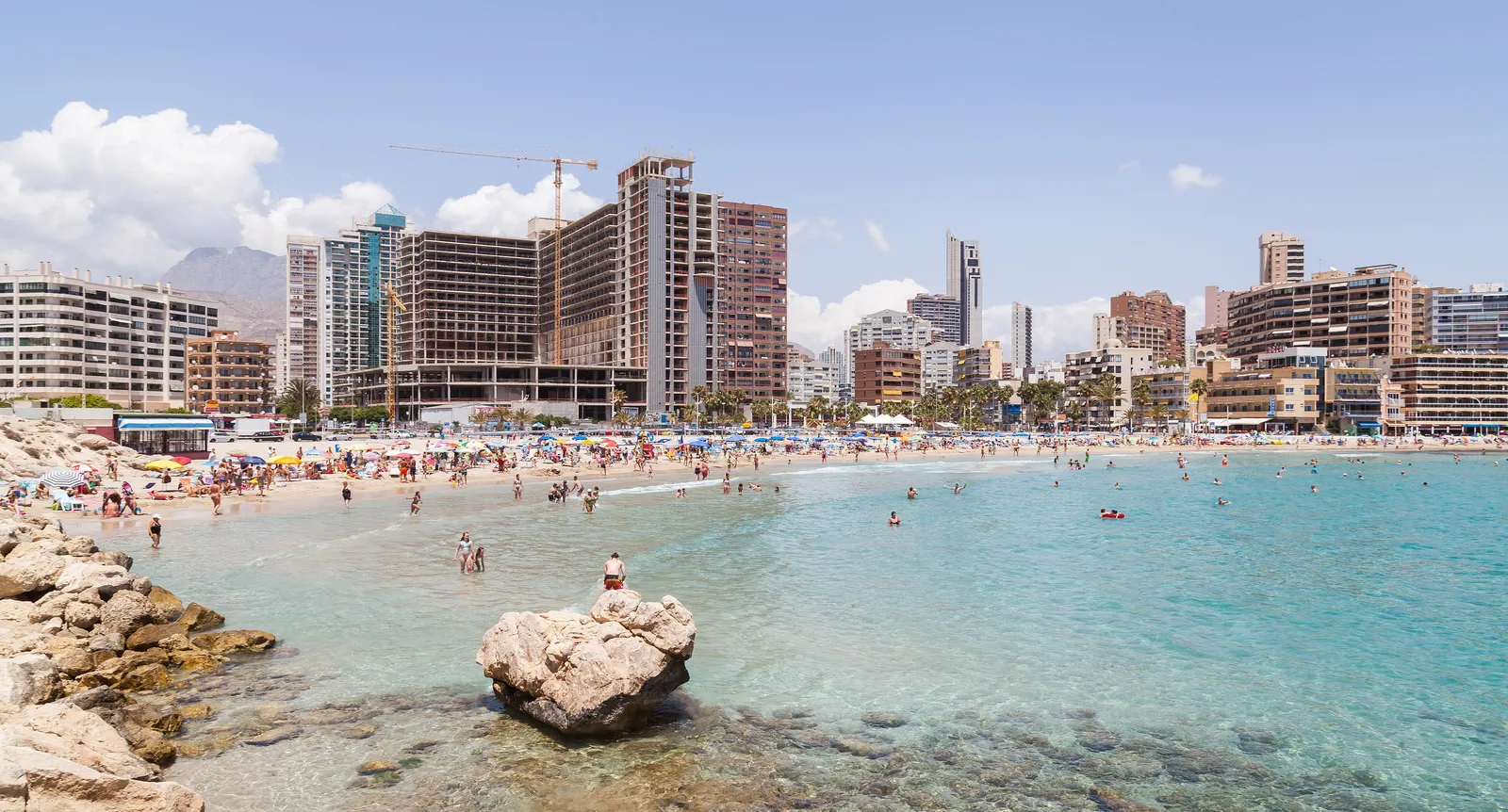
Two things cut the other way. About 450,000 unsold new homes remained at the time of that report, though the bank suggested many may not match what households want. And building is picking up: starts in the east, south and island provinces rose 19.7 per cent in the 12 months to June. See our guide to new build and resale in Spain.
Is the Spanish property market going to crash?
Nobody can promise it won't. On official data at the end of October 2026 the market does not look like 2007, but several warning lights are on.
| Indicator | Boom years | Latest |
|---|---|---|
| New homes finished each year | About 650,000, 2006 to 2008 | About 92,000, 2025 |
| Prices above what income and rates suggest | Average peak of 24 per cent, late 2007 | 10 to 15 per cent, December 2025 |
| House prices after inflation | Peak in Q3 2007 | 14.7 per cent below it, end of 2025 |
Debt is one big difference. Home loans outstanding were 29.9 per cent of GDP in December 2025, low by historical standards. New loans averaged 80.4 per cent of the purchase price at the end of 2025, and the Banco de España says lending standards are still tighter than in the 2000s boom. Bad home loans fell to 1.45 per cent in the second quarter of 2026, from 2.52 per cent in 2023. In its spring 2026 report the bank called real estate risks to financial stability contained, though that came before the ECB's two rate rises.
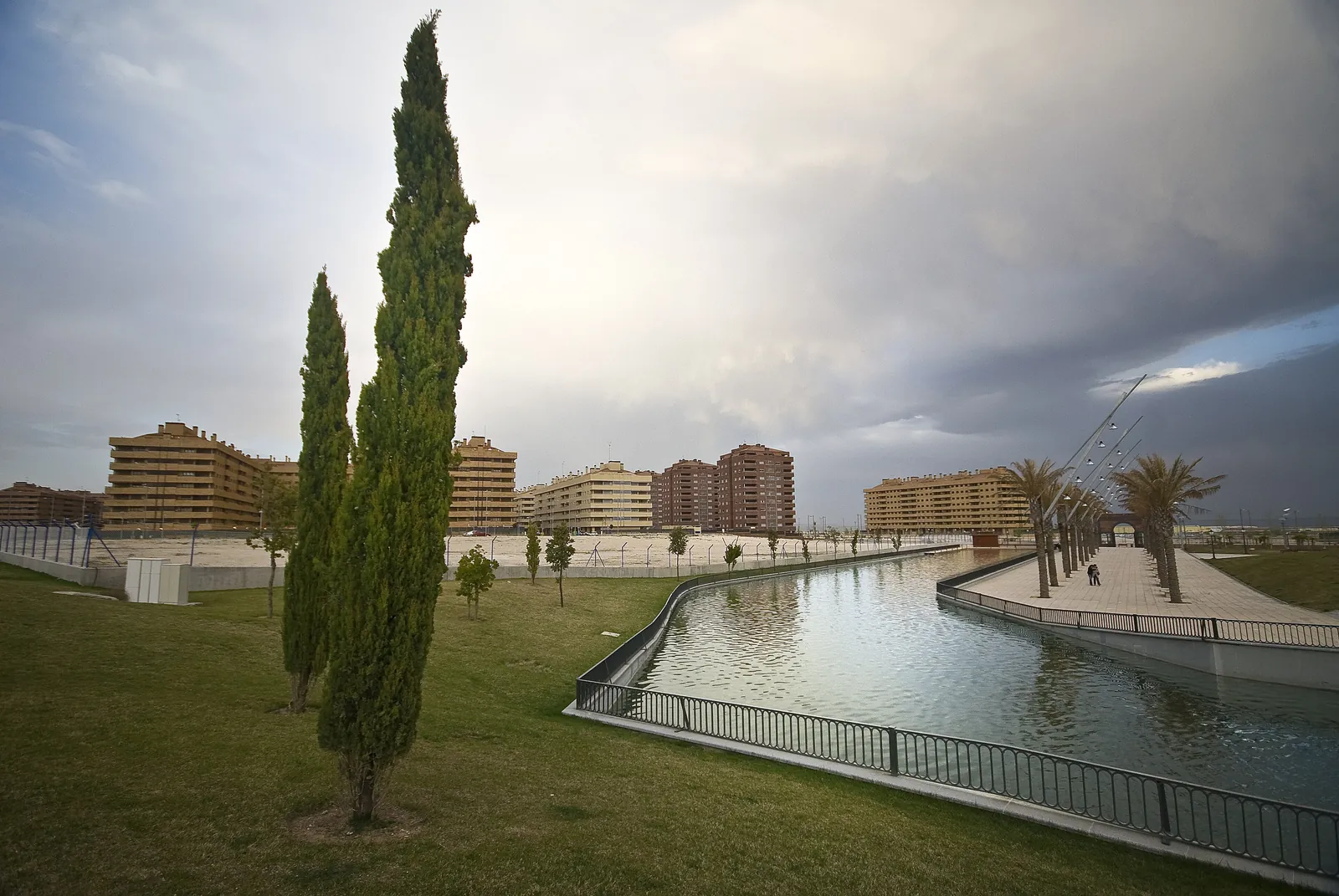
What are the warning signs?
- Affordability. In the second quarter of 2026 the Banco de España put home prices at 8.4 years of household income, up from 7.1 in 2024. The theoretical cost of a loan takes 38.0 per cent of income, up from 34.3 per cent in 2025.
- Interest rates. The ECB raised rates in June and September 2026, to a deposit rate of 2.50 per cent. Twelve-month Euribor averaged 3.247 per cent in September, against 2.172 per cent a year earlier.
- Foreclosures. The 4,962 foreclosure certificates on homes in the second quarter were the most since early 2022 and 21 per cent up on the year, though from a low base.
- Foreign demand. Registers show a record foreign share, but notaries show foreign purchases down 13 per cent to 62,327 in the first half of 2026, the biggest fall since 2020.
- History. Eurostat's index fell 36.9 per cent from the third quarter of 2007 to the first quarter of 2014. It took until the first quarter of 2024 to pass the old peak, more than 16 years later.
What does this mean for UK and Irish buyers?
- Sterling cost. At the average price, 90 square metres cost about £154,000 in the first quarter of 2024 and about £187,000 at the ECB rate on 30 October 2026, before costs. Irish buyers pay in euros, so they avoid that exchange risk.
- Buying costs. Budget up to 13 to 14 per cent on top of the listing price. On the Costa Blanca, resale tax (ITP) has been 9 per cent since 1 June 2026, and new builds pay 10 per cent VAT. Our guide to purchase costs has the detail.
- Mortgages. A euro loan paid from sterling income moves with both Euribor and the exchange rate. Read our guide to mortgages for foreigners first.
- British and Irish demand. The British are still the largest foreign group in the registers, only just ahead of the Dutch, and the Irish made 1.82 per cent of foreign purchases. Notaries put the British second behind Moroccan buyers, with 4,541 purchases in the first half of 2026. Euro Weekly News reports that as a 21 per cent fall. See our report on foreign buyers in Spain.
- Time in Spain. Buying needs no visa, but British owners without residency are limited to 90 days in any 180 across the Schengen area. Irish citizens are in the EU, so that limit does not apply.
- Renting it out. Published yields depend on the method. For the third quarter of 2026 the Banco de España series shows a national gross yield of 2.8 per cent and an idealista study 6.2 per cent. Both have fallen, and local results vary a lot.
What is the latest Spanish property market news?
- General election. Parliament was dissolved in October and Spain votes on 29 November 2026, so housing policy may change.
- The 100 per cent tax. The proposed tax on non-EU, non-resident buyers was not law at the end of October.
- Next data. The registrars' third quarter report and INE's next house price index will show whether softer sales have reached prices.
Frequently asked questions
Are Spanish property prices falling in 2026?
No, not nationally. INE's house price index rose 12.2 per cent in the year to the second quarter of 2026, and every region was up. The rate of growth has eased a little, asking-price growth is slowing, and the average new-build price dipped 0.7 per cent on the quarter.
Will the Spanish property market crash?
Nobody can say for certain. Official data shows less building, lower household debt and smaller price imbalances than in 2007. Against that, affordability is worsening, mortgage rates have turned up and foreclosure certificates are rising from a low base. Spanish prices fell about 37 per cent between 2007 and 2014.
Where is property most expensive in Spain?
Madrid led in the second quarter of 2026 at €4,477 per square metre, followed by the Balearic Islands at €4,311, the Basque Country at €3,616, the Canary Islands at €3,052 and Catalonia at €2,995. Extremadura was the cheapest region at €947. Alicante province averaged €2,267.
Is 2026 a good time to buy property in Spain?
That depends more on your plans than on the headlines. For a home you will use for many years, check that today's price and mortgage rate work for your budget. If you might need to sell within a few years, remember buying costs of up to 13 to 14 per cent, and that prices have fallen before.
Is Spain's 100 per cent tax on British buyers law?
No. The proposed tax on non-EU, non-resident buyers was not in force at the end of October 2026. The Local reported that it had not been debated by the end of March and is not among the housing measures in force. Parliament has since been dissolved, so check again after the election on 29 November.
Thinking of buying in Spain in 2026?
National averages only take you so far, because prices differ from one town to the next. Have a look at homes for sale in Torrevieja, then talk to us about the numbers where you want to live. Tripinvest ES is a licensed agency, RAICV 4221, with offices in Calpe, Torrevieja and London. We work in English from first call to the notary, and our clients don't pay us commission. Call +44 20 3888 0008 or get in touch below.
Sources
Last checked: October 2026
- Colegio de Registradores: Estadística Registral Inmobiliaria, Q2 2026, published August 2026
- Colegio de Registradores: Estadística Registral Inmobiliaria, Q1 2024
- INE: house price index, Q2 2026, published 7 September 2026
- INE: property transfer statistics, August 2026, published 26 October 2026
- INE: mortgage statistics, August 2026, published 26 October 2026
- Banco de España: property market indicators, 29 October 2026
- Banco de España: Financial Stability Report, Spring 2026
- Banco de España: Annual Report 2023, chapter 4, the housing market
- BOE: Banco de España mortgage reference rates, September 2026
- European Central Bank: key interest rates
- European Central Bank: euro reference rate against sterling
- Eurostat: quarterly house price index, prc_hpi_q
- BOE: Real Decreto 806/2026, dissolving Parliament and calling elections
- Notariado: foreign home purchases, first half of 2026, published 15 October 2026
- GOV.UK: Spain entry requirements
- The Local: status of the proposed 100 per cent tax, 19 October 2026, updated 24 October
- Euro Weekly News: notary figures for the first half of 2026, 31 October 2026
- Bolsamanía: idealista gross yields, third quarter 2026, 13 October 2026
- idealista/news: resale asking prices, third quarter 2026, 2 October 2026