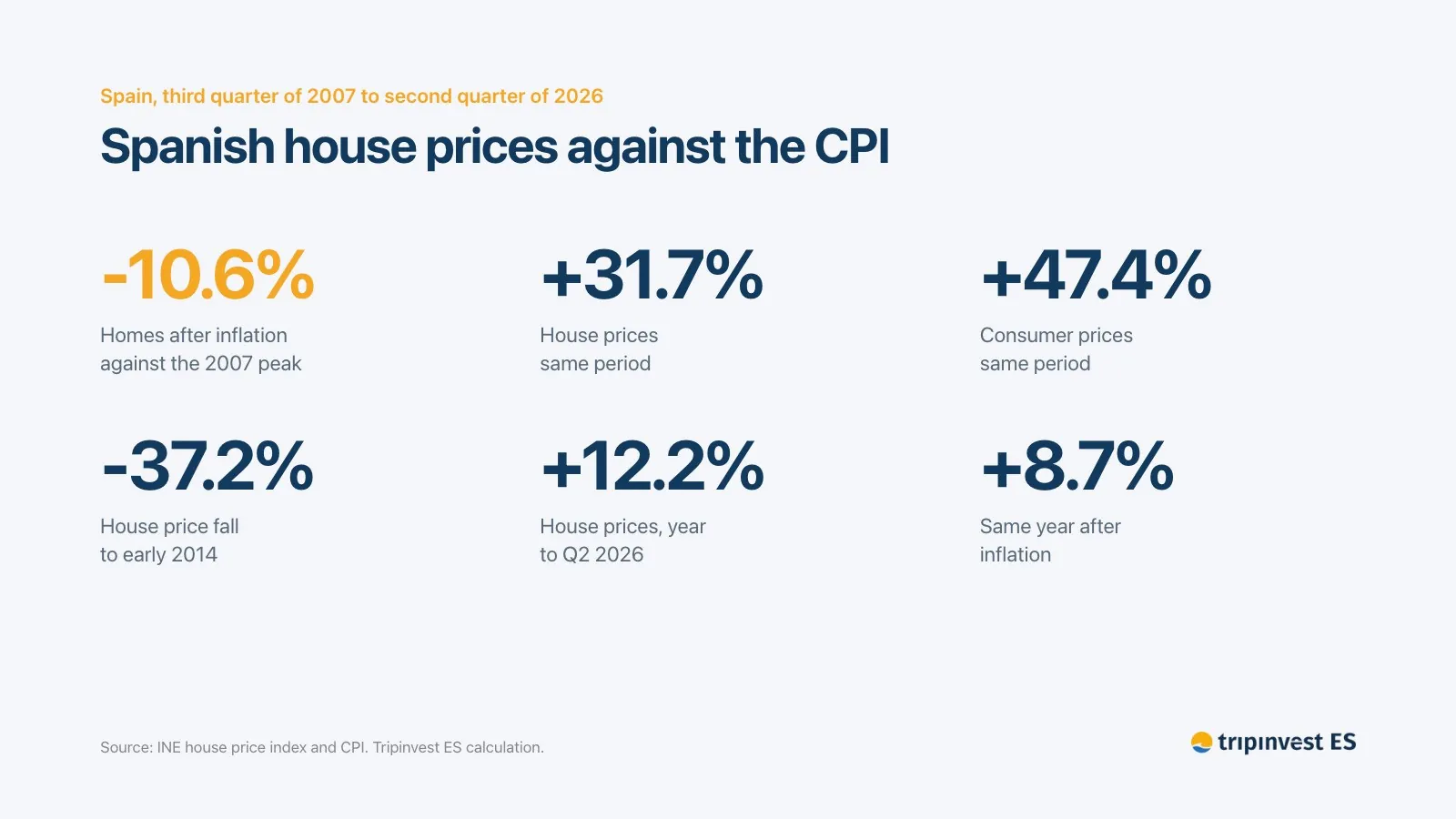
Spanish house price inflation was 12.2 per cent in the year to the second quarter of 2026, or about 8.7 per cent after consumer prices. Yet in real terms Spanish homes remain about 10.6 per cent below their peak of the third quarter of 2007, because the CPI has risen further than house prices since then.
What is Spanish house price inflation right now?
The official measure is the house price index (IPV) from INE, Spain's statistics office. It tracks the sale prices of open-market homes, leaving out social housing, and adjusts for the mix and quality of what sold. These figures for the second quarter of 2026 came out on 7 September 2026.
- All homes: up 12.2 per cent on the year and 3.4 per cent on the quarter
- Second-hand homes: up 12.9 per cent on the year
- New homes: up 7.4 per cent on the year
- Comunitat Valenciana, which includes the Costa Blanca: up 13.0 per cent
- Región de Murcia: up 14.4 per cent
- Andalucía: up 11.9 per cent
The annual rate has eased slightly from 12.9 per cent in the previous quarter. Eurostat's version of the index shows Spain at 12.1 per cent against 4.7 per cent for the EU as a whole.
Consumer prices rose 3.2 per cent over the same year, on the quarterly average of INE's CPI. That gives a real rise of about 8.7 per cent. General inflation has picked up since. The CPI reached 4.9 per cent in September 2026, the highest since February 2023, with core inflation at 3.1 per cent.
How have Spanish house prices moved against the CPI since 2007?
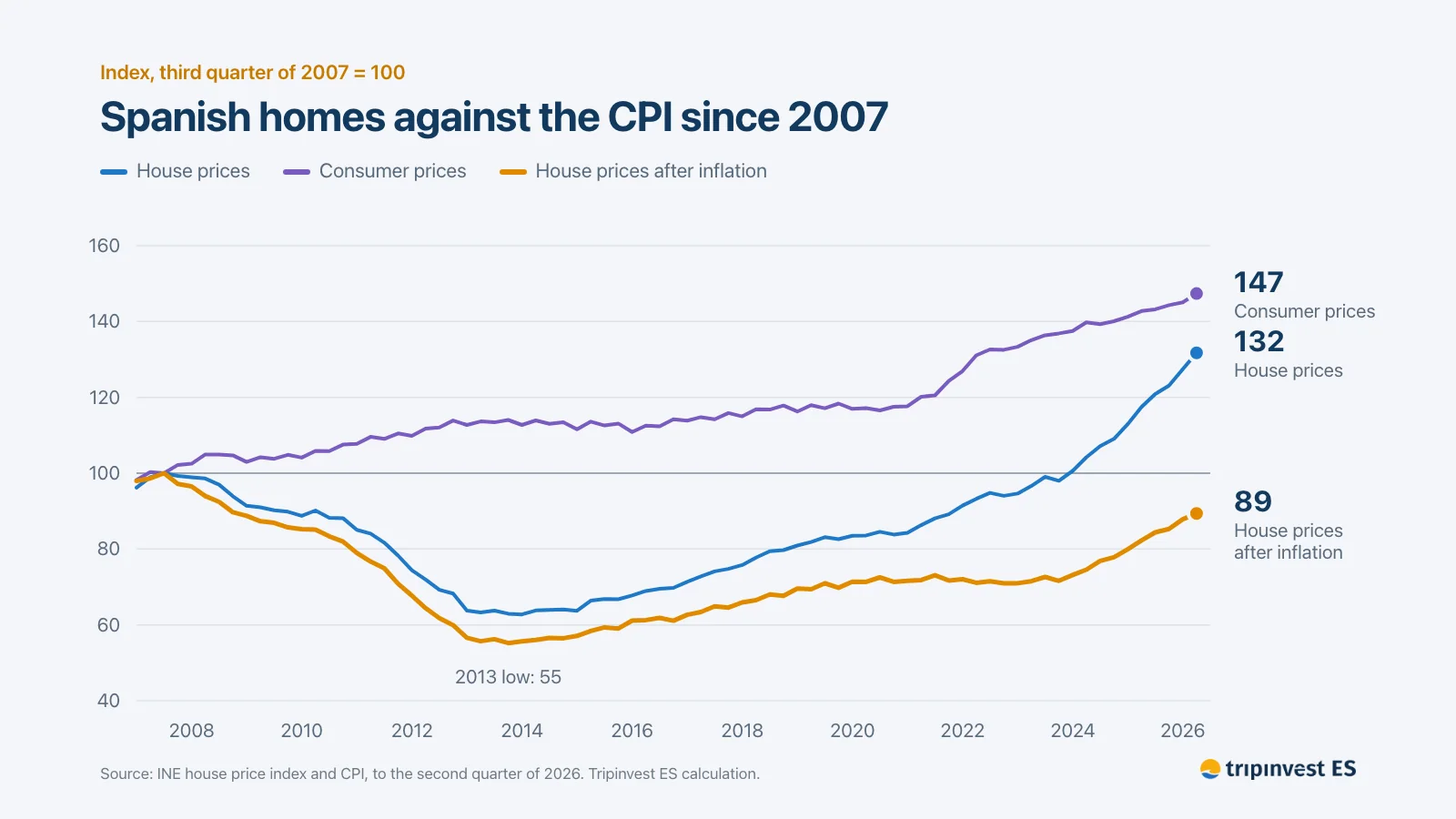
To get real house prices, divide the house price index by the CPI for each quarter. We start at the third quarter of 2007, the pre-crisis peak the Banco de España also uses.
| Period, change in per cent | House prices | Consumer prices | After inflation |
|---|---|---|---|
| Q3 2007 to Q1 2014: the crash | Down 37.2 | Up 12.7 | Down 44.3 |
| Q1 2014 to Q4 2019: the recovery | Up 31.6 | Up 5.0 | Up 25.4 |
| Q4 2019 to Q2 2026: the recent run | Up 59.5 | Up 24.5 | Up 28.1 |
| Whole period, Q3 2007 to Q2 2026 | Up 31.7 | Up 47.4 | Down 10.6 |
So a record in euros is not a record in real terms. Over almost 19 years the index gained 31.7 per cent and the shopping basket 47.4 per cent. Divide one by the other and you get 0.894, which is the 10.6 per cent gap.
Our method matches the central bank's own figure. The Banco de España put real house prices 14.7 per cent below the 2007 peak at the end of 2025, and the same sum gives us 14.7 per cent for that quarter. The gap has closed by about four points in the two quarters since. Real prices are now about where they stood in late 2008.
Spain house price growth against inflation, year by year
These are annual averages, apart from the last row, and 2024 and 2025 match the rates the Banco de España reports.
| Change in per cent | House prices | CPI | After inflation |
|---|---|---|---|
| 2019 | 5.1 | 0.7 | 4.3 |
| 2020 | 2.1 | Down 0.3 | 2.4 |
| 2021 | 3.7 | 3.1 | 0.6 |
| 2022 | 7.4 | 8.4 | Down 0.9 |
| 2023 | 4.0 | 3.5 | 0.4 |
| 2024 | 8.4 | 2.8 | 5.5 |
| 2025 | 12.7 | 2.7 | 9.7 |
| Year to Q2 2026 | 12.2 | 3.2 | 8.7 |
When inflation spiked in 2022, house prices did not keep pace. Almost all of the real gain since 2020 came in the last two and a half years. For the wider picture, see how the Spanish economy works.
Prices lost ground to the CPI in every year from 2008 to 2013. The worst was 2012, down 15.8 per cent after inflation.
Why have Spanish house prices outrun inflation lately?
Demand has run ahead of supply. The Banco de España counts a net 225,000 new households in 2025 and 55,000 homes bought by non-residents, against about 92,000 new homes completed.
Spain has recovered from the global financial crisis and foreign buyers remain an important part of the market, with a record 15.98 per cent of home purchases in the second quarter of 2026. The British were the largest foreign group, at 6.99 per cent of foreign purchases.
The index also hides a split. New homes are about 13 per cent above their third quarter 2007 level in real terms. Second-hand homes are about 21 per cent below it. Second-hand homes made up 79.21 per cent of registered sales in the second quarter of 2026, so that is the number most buyers live with. Our guide to new build and resale in Spain covers the choice itself.
Why do Spanish house price indices disagree?
They measure different things, so the gap to 2007 shifts with the source. These figures are for the second quarter of 2026.
| Change in per cent | What it tracks | Year on year | Against its 2007 or 2008 high | After inflation |
|---|---|---|---|---|
| INE house price index | Sale prices, quality adjusted | Up 12.2 | Up 31.7 | Down 10.6 |
| Colegio de Registradores repeat sales | The same homes sold twice | Up 16.7 | Up 39.3 | Down about 5.5 |
| Ministry of Transport appraisal value | Average valuation, €2,355 per square metre | Up 12.5 | Up 12.1 | Down about 22.1 |
The last column is our sum, using INE's CPI. None of the three puts Spain above its 2007 peak after inflation. If a headline says record prices, check whether it means in euros.
What do the numbers show on the Costa Blanca?
INE only publishes its index by region. The Comunitat Valenciana is up 29.7 per cent on the third quarter of 2007. Regional consumer prices rose 46.7 per cent, which leaves it about 11.6 per cent below in real terms, close to the national gap.
For towns, the best official source is the ministry's appraisal value. It covers municipalities above 25,000 residents, so Altea is not listed. We took each place's highest quarter before 2012 and deflated it with INE's CPI for Alicante province.
| Place | Pre-crisis high (per square metre) | Q2 2026 | Change in euros, per cent | After inflation, per cent |
|---|---|---|---|---|
| Alicante province | €1,764 (Q2 2008) | €2,021 | Up 14.5 | Down 17.8 |
| Alicante city | €2,003 (Q1 2008) | €2,279 | Up 13.8 | Down 20.5 |
| Torrevieja | €2,145 (Q4 2007) | €2,254 | Up 5.1 | Down 26.8 |
| Orihuela, with Orihuela Costa | €2,009 (Q2 2008) | €2,080 | Up 3.5 | Down 25.7 |
| Santa Pola | €2,163 (Q2 2007) | €2,614 | Up 20.8 | Down 17.1 |
| Benidorm | €2,915 (Q2 2006) | €3,217 | Up 10.3 | Down 26.0 |
| Dénia | €2,875 (Q4 2007) | €2,985 | Up 3.8 | Down 27.7 |
| Calpe | €2,645 (Q4 2006) | €3,269 | Up 23.6 | Down 17.1 |
| Jávea (Xàbia) | €2,481 (Q4 2005) | €3,507 | Up 41.4 | Down 7.6 |
These are valuations rather than sale prices, and a town quarter rests on few homes: 133 in Calpe, 716 in Torrevieja. So one high quarter can move a row. Dénia's €2,875 stands well above the quarters around it: against €2,360 in early 2007 it would be down about 15 per cent after inflation. Jávea, against €2,415 in early 2008, would be about level. Even so, most of the coast is behind the CPI since the last boom, and Torrevieja has barely passed its 2007 level in euros. Our guide to property in Torrevieja covers the town itself.
Registered sales in Alicante province averaged €2,267 per square metre in the second quarter of 2026, up 2.4 per cent on the quarter. Foreign buyers made 46.43 per cent of purchases there, the highest share in Spain.
How does this compare with the UK, and what if you earn in pounds?
Over the same stretch, real house prices in both countries have ended up in nearly the same place. The route was very different.
| Change in per cent | Spain | United Kingdom |
|---|---|---|
| House prices, Q3 2007 to Q2 2026 | Up 31.7 | Up 55.4 |
| Consumer prices, same period | Up 47.4 | Up 74.2 |
| After inflation | Down 10.6 | Down 10.8 |
| House prices, Q4 2019 to Q2 2026 | Up 59.5 | Up 26.8 |
| After inflation, same period | Up 28.1 | Down 3.3 |
The UK figures use the UK House Price Index and ONS CPI. UK prices rose 0.9 per cent in the year to August 2026, to about £273,000.
Currency adds a second layer. The pound bought about €1.47 in the third quarter of 2007 and about €1.15 in the second quarter of 2026, on ECB averages. A home matching the index cost €100,000, or about £68,000, in 2007. It now costs about €131,700, or about £114,100. That is a rise of about 68 per cent in pounds, ahead of UK house prices but short of the UK CPI. Irish buyers earn in euros and can skip this step.
What does the house price index not tell you?
- An index is not your home. It covers all open-market sales, so a flat in Dénia and a villa in Málaga sit in the same national number.
- Buying costs come first. Budget up to 13 to 14 per cent on top of the listing price, which is up to €28,000 on a €200,000 home. The index ignores this. Our guide to buying costs in Spain has the breakdown.
- Spanish tax looks at the gain in euros. Non-residents pay 19 per cent on a capital gain, and the inflation correction for property was scrapped for sales from 1 January 2015. A sale that only matches the CPI can still produce a taxable gain.
- Running costs are not in the index. Local property tax, community fees and repairs come out of your own pocket.
- Prices have moved away from incomes. The Banco de España's indicators, which compare prices with income and interest rates, gave a reading of 10 to 15 per cent at December 2025. That is similar to 2004 and well below the 24 per cent average peak of late 2007. It names the split between prices and household income since 2024 as the main factor.
- Sales have dipped. Spain recorded 167,934 home sales in the second quarter of 2026, about 2 per cent fewer than a year earlier.
Past price changes do not tell you what will happen next. For the investment side, read whether Spain is a good market for property investment. For older regional detail, our Q1 2024 housing market statistics give a dated snapshot.
Frequently asked questions
What is the current house price inflation in Spain?
INE's house price index rose 12.2 per cent in the year to the second quarter of 2026, down from 12.9 per cent the quarter before. Second-hand homes rose 12.9 per cent and new homes 7.4 per cent. Consumer prices rose about 3.2 per cent over the same year.
Are Spanish house prices rising faster than inflation?
Yes, at the moment. In 2025 house prices rose 12.7 per cent against average inflation of 2.7 per cent, a real rise of 9.7 per cent. That has not always held. In 2022 inflation of 8.4 per cent beat house price growth of 7.4 per cent, and prices lost ground every year from 2008 to 2013.
Are Spanish house prices above their 2007 peak?
In euros, yes. INE's index was 31.7 per cent above its third quarter 2007 peak by the second quarter of 2026. After inflation, no. Consumer prices rose 47.4 per cent over the same period, which leaves homes about 10.6 per cent below that peak in real terms.
What is the Spanish house price index?
The Spanish house price index, or IPV, is published every quarter by INE, Spain's statistics office. It tracks the sale prices of open-market homes, new and second-hand, and adjusts for changes in the mix and quality of homes sold. The base year is 2025, and the series starts in 2007.
Are property prices rising in Spain and on the Costa Blanca?
Yes. INE's index rose 12.2 per cent nationally and 13.0 per cent in the Comunitat Valenciana in the year to the second quarter of 2026. Ministry valuations in Alicante province rose 14.1 per cent. Even so, those valuations sit about 18 per cent below their 2008 high after inflation.
Does Spanish property protect you against inflation?
It depends on when you bought. A buyer at the 2007 peak is still behind the CPI after almost 19 years, while a buyer in early 2014 is well ahead on these figures. National averages also ignore buying costs of up to 13 to 14 per cent on top of the listing price, tax and upkeep.
Looking at a home on the Costa Blanca?
An index tells you about Spain, not about one street in one town. Tell us your budget and where you want to be, and we will show you what the market looks like there. Start with properties for sale in Torrevieja, or use our guide to checking a property in Spain before you commit.
We help you find the right home, guide you through the mortgage and the paperwork, and keep an eye on deadlines. Tripinvest ES is a licensed agency (RAICV 4221), with service in English from the first call to the notary. Our clients don't pay us commission.
Prefer to talk? Call us on +44 20 3888 0008.
Sources
Last checked: October 2026. Real-terms figures are Tripinvest ES calculations from these official series.
- INE: house price index, second quarter 2026
- INE: house price index methodology, base 2025
- INE: house price index data table, 2007 to 2026
- INE: national CPI index, monthly series
- INE: CPI for Alicante province
- INE: CPI for the Comunitat Valenciana
- INE: CPI, September 2026
- Banco de España: Financial Stability Report, spring 2026, chapter 4
- Colegio de Registradores: Estadística Registral Inmobiliaria, second quarter 2026
- Ministerio de Transportes: appraisal values by province
- Ministerio de Transportes: appraisal values by town
- Eurostat: house price index, quarterly data (prc_hpi_q)
- European Central Bank: euro to sterling, quarterly averages
- ONS: UK CPI index (D7BT)
- HM Land Registry: UK House Price Index average prices to August 2026
- BOE: Real Decreto Legislativo 5/2004 on non-resident income tax, articles 24 and 25
- BOE: Ley 26/2014, tax reform removing the correction coefficients for property
- Agencia Tributaria: non-resident tax manual, gains on selling property