Rental yield Spain: how to work out gross and net figures
Rental yield in Spain is a year's rent divided by what the property cost. Idealista put the average gross yield at 6.2 per cent in the third quarter of 2026, before any costs or tax. In our Costa Blanca example, a 6 per cent gross yield falls to 2.7 per cent net for a UK owner.

What is rental yield in Spain?
Rental yield is the rent a property brings in over a year, shown as a percentage of its cost. There are two versions.
- Gross yield: annual rent divided by the price, times 100.
- Net yield: annual rent, less running costs and tax, divided by the price plus buying costs, times 100.
What is the difference between gross and net rental yield?
| Gross yield | Net yield | |
|---|---|---|
| Rent used | Full asking rent | Rent actually collected |
| Divided by | Listing price | Price plus buying costs |
| Empty weeks | Ignored | Counted |
| Community fees, IBI, insurance, repairs | Ignored | Counted |
| Spanish tax | Ignored | Counted |
| Where you see it | Portals and adverts | Usually only in your own sums |
What are the best rental yields in Spain?
The highest published yields tend to be in cheaper cities, not the famous ones.
| Place | Gross yield | Source and period |
|---|---|---|
| Spain | 6.2 per cent | idealista, Q3 2026 (6.9 a year earlier) |
| Huelva | 7.4 per cent | idealista, Q3 2026 |
| Murcia | 6.8 per cent | idealista, Q3 2026 |
| Barcelona | 4.4 per cent | idealista, Q3 2026 |
| Madrid | 4.3 per cent | idealista, Q3 2026 |
| Valencia province | 10.3 per cent average | Euroval, 2025 listings |
| Elche | Near 8 per cent | Euroval, 2025 listings |
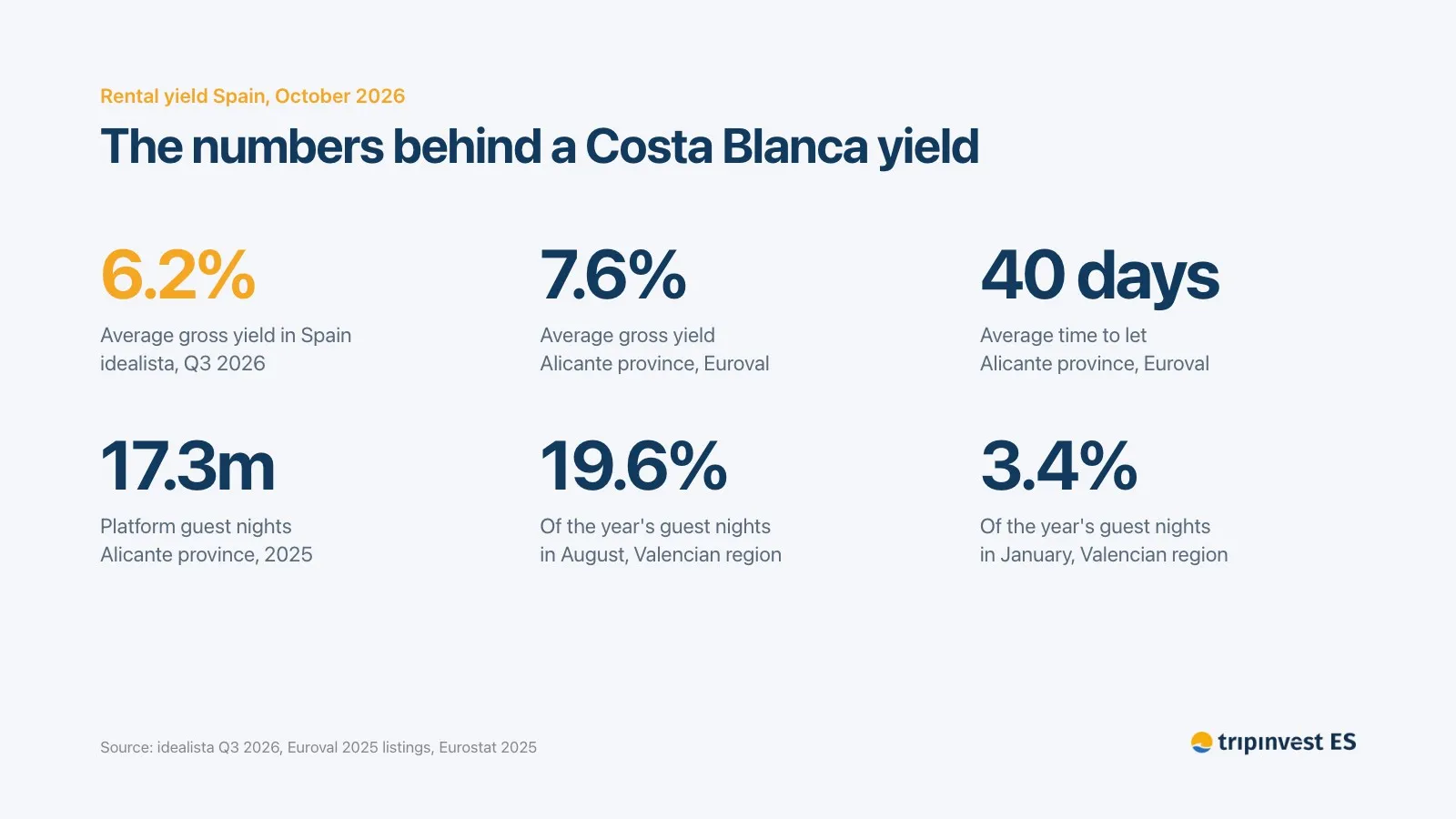
| Alicante province | 7.6 per cent average | Euroval, 2025 listings |
Alicante province looks strong, but the average flatters it. Euroval's average sits 1.3 points above the median, which puts the typical yield nearer 6.3 per cent. Its average rent was about €14,513 a year, yet most rents fell between €10,000 and €12,500. These are asking figures from two different studies, so compare them loosely, and past figures do not tell you what comes next.
Why have Spanish rental yields been falling?
Yield falls when prices rise faster than rents. Idealista's national figure went from 7.2 per cent in the second quarter of 2025 to 6.5 per cent a year later.
From 2014 to 2023, Spain's house price index rose by about 4.4 per cent a year on average, with a quarterly high of 8.5 per cent in early 2022. Across the euro area, the annual rate stood at -2.2 per cent in the third quarter of 2023. Even so, average house prices in Spain were still below their 2008 highs at that point.
That has since changed. By the second quarter of 2026 the average registered price reached a record €2,487 per square metre, according to the Registradores, and INE's house price index was up 12.2 per cent on the year, or 13.0 per cent in the Valencian region. Alicante province averaged €2,267. See our post on Spanish house price inflation.
How do you work out net rental yield on a Costa Blanca flat?
Five steps:
- Estimate a year's rent after empty weeks.
- Take off every running cost.
- Take off Spanish tax for the country you live in.
- Add buying costs to the price.
- Divide the first result by the second, then multiply by 100.
Here is the sum on a resale flat bought in cash. It is our own illustration.
- Price: €200,000, near Euroval's €191,119 average for Alicante province.
- Buying costs: €26,000, so €226,000 all in. Allow up to 13 to 14 per cent on top of the listing price. See our guide to purchase costs in Spain.
- Long let: €1,000 a month, 6 per cent gross and in line with Euroval's implied median of about €12,000 a year. One month stays empty, given Euroval's 40-day average time to let.
- Holiday let: 22 weeks: 8 at €900, 9 at €500 and 5 at €300. These are our inputs, not market data.
- Community fees: €100 a month, inside the €30 to €150 often seen on the Costa Blanca.
- IBI, insurance and repairs: €1,000 a year. Torrevieja's IBI is 0.4 per cent of cadastral value, the legal minimum, or about €220 on an average home.
- Holiday let extras: bills at €150 a month, cleaning at €60 a week let, and management and booking fees of 20 per cent.
| One year on a €200,000 flat | Long let | Holiday let |
|---|---|---|
| Rent collected | €11,000 | €13,200 |
| Gross yield on the price | 5.5 per cent | 6.6 per cent |
| Community fees | €1,200 | €1,200 |
| IBI, insurance, repairs | €1,000 | €1,000 |
| Power, water, internet | €0 | €1,800 |
| Cleaning | €0 | €1,320 |
| Management and booking fees | €0 | €2,640 |
| Left before tax | €8,800 | €5,240 |
| Net yield before tax, on €226,000 | 3.9 per cent | 2.3 per cent |
| Spanish tax, UK resident | €2,640 | €3,168 |
| Left, UK resident | €6,160 | €2,072 |
| Net yield, UK resident | 2.7 per cent | 0.9 per cent |
| Spanish tax, Irish resident | €1,672 | €996 |
| Left, Irish resident | €7,128 | €4,244 |
| Net yield, Irish resident | 3.2 per cent | 1.9 per cent |
The holiday let wins on gross and loses on net, because the extra income goes on servicing the flat. Tax widens the gap. UK residents pay 24 per cent on all the rent with no expenses deducted, while EU residents pay 19 per cent after related costs. UK residents normally declare the rent to HMRC too.
Three things sit outside the table.
- VAT on short lets. From 1 December 2026, Real Decreto-ley 29/2026 is due to charge VAT at 10 per cent on furnished lets of up to 30 nights, unless it is your main home. If guests will not pay more, about €1,200 of the €13,200 would be VAT, before any VAT you can reclaim on costs.
- Imputed income. Spain taxes it for the days the flat is not let. On the holiday let that is about €150 a year for a UK resident, at a €100,000 cadastral value where the 1.1 per cent rate applies.
- Your own use. The holiday let leaves you 30 weeks in the flat, the long let none. That may matter more to you than a percentage point.

How many weeks can a Costa Blanca holiday let fill?
Fewer than a summer visit suggests. Eurostat's monthly figures for online platform stays stop at regional level, so this table covers the whole Valencian region, where Alicante province made up about 62 per cent of nights in 2025.
| Valencian region, 2025 | Guest nights | Share of the year |
|---|---|---|
| July and August | 10.33 million | 36.8 per cent |
| April to June, September, October | 11.60 million | 41.4 per cent |
| November to March | 6.12 million | 21.8 per cent |
August alone took 19.6 per cent of the year and January 3.4 per cent, so August was nearly six times as busy. Our 22 weeks follow that pattern, with 36 per cent of them in July and August. That is about 42 per cent of the year let, so test it against real booking records.
Alicante province logged 17.3 million platform guest nights in 2025, up 14 per cent on 2024.

What changes a rental yield the most?
Change one input at a time, using the UK resident results above.
| Change | Left each year | Net yield |
|---|---|---|
| Long let, base case | €6,160 | 2.7 per cent |
| Two months empty, not one | €5,400 | 2.4 per cent |
| Community fees €200 a month, not €100 | €4,960 | 2.2 per cent |
| Holiday let, base case | €2,072 | 0.9 per cent |
| 10 per cent VAT absorbed, none reclaimed | €1,160 | 0.5 per cent |
| Four more low season weeks | €2,504 | 1.1 per cent |
| Peak weeks at €1,100, not €900 | €2,968 | 1.3 per cent |
| Self-managed, no 20 per cent fee | €4,712 | 2.1 per cent |
The management fee moves the holiday let most. Winter weeks add little.
What do yield calculators leave out?
- Whether you can let at all. In a flat, tourist letting has needed the community's express approval, by a three-fifths majority, since 3 April 2025. Alicante city suspended new licences for up to two years from 13 January 2025, and Altea and Dénia limit them zone by zone. See our post on buying property in Spain to rent out.
- Long lets tie up the home. With a private landlord, a tenant can extend year by year up to five years. Real Decreto-ley 29/2026 also caps rent rises due by 31 December 2027 at 2 per cent, unless you agree otherwise.
- Winter lets have new rules. Since 8 October 2026, the same decree requires a temporary let to run more than 31 days and to have a real, provable reason. Without one, it counts as a main-home lease.
- Buying costs take years to recover. At €226,000 all in, the flat must sell for 13 per cent above its price just to return your money, before selling costs.
The decree still needs validating by parliament, and no validation had appeared in the BOE by 31 October 2026, so check the position before you sign. Before you trust any figure, check the property, including its community fees.
Do a mortgage and the pound change the yield?
Yes, and they can work against you. Non-residents can usually borrow up to 60 to 70 per cent of the value. Take a €140,000 variable loan at 5.25 per cent: 12-month Euribor of 3.247 per cent in September 2026, plus the 2 per cent broker margin quoted by A Place in the Sun. First-year interest is about €7,300. That is more than the €6,160 a UK resident keeps from the long let, and UK residents cannot deduct it. See our guide to the mortgage for foreigners.
A Spanish flat is a euro asset, and rates move both ways. The ECB rate was £0.8846 per euro on 14 November 2025 and £0.8338 on 30 October 2026, the high and low of the 12 months to that date. That made €226,000 about £199,900 and then about £188,400.
What is a good rental yield?
There is no official benchmark, so compare your net figure with a low-risk alternative. Idealista quoted the 10-year Spanish government bond at 3.4 per cent in the second quarter of 2026. A 6.2 per cent gross yield looks well clear of that. A net yield near 3 per cent does not.
Rent is only part of the case. You are also buying the use of a home, and an asset whose price can move either way. Our post on property investment in Spain weighs that up. For real prices to test, see our Torrevieja property guide and current homes in Torrevieja.
Frequently asked questions
How do you calculate rental yield in Spain?
Divide a year's rent by the price and multiply by 100 for gross yield. For net yield, take empty weeks, running costs and tax off the rent, then divide by the price plus buying costs. A €200,000 flat renting at €12,000 a year shows 6 per cent gross.
Where is the highest rental yield in Spain?
Among provincial capitals, idealista put Huelva top at 7.4 per cent in the third quarter of 2026, ahead of Castellón de la Plana at 7.2 per cent. Euroval put Valencia province at 10.3 per cent and Elche near 8 per cent on 2025 listings. These are gross figures based on asking prices and rents, before any costs.
What is a good rental yield in Spain?
No official benchmark exists. A useful test is your net yield after costs and tax against a low-risk alternative, such as the 10-year Spanish government bond at 3.4 per cent in the second quarter of 2026. Compare net with net, because gross figures make almost any flat look strong.
Is rental income in Spain taxed for UK owners?
Yes. UK residents pay Spanish non-resident tax of 24 per cent on all rent and cannot deduct expenses. Residents of the EU, Iceland, Norway and Liechtenstein pay 19 per cent and can deduct related costs. UK residents normally declare the rent to HMRC too, and relief may be available.
Is a holiday let better than a long let for yield?
Not always. In our example the holiday let earned €13,200 against €11,000, yet left a UK resident €2,072 against €6,160 after fees, bills, cleaning and tax. A holiday let does leave you weeks to use the flat, and it needs licence and community approval first.
Want to run the sum on a real flat?
Send us the home you are looking at, or your budget and towns, and we'll go through the numbers with you. We help you find the right property, guide you through the mortgage and the paperwork, and keep an eye on deadlines. Tripinvest ES is a licensed agency (RAICV 4221), with service in English from the first call to the notary. Our clients don't pay us commission. Or call us on +44 20 3888 0008.
Sources
Last checked: October 2026
- Eurostat: short-stay accommodation via online platforms by month, Valencian region (tour_ce_omn12)
- Eurostat: platform guest nights by province, Alicante (tour_ce_oan3)
- Eurostat: annual house price index, Spain (prc_hpi_a)
- INE: house price index, second quarter 2026
- Colegio de Registradores: Estadística Registral Inmobiliaria, second quarter 2026
- Agencia Tributaria: non-resident tax rates
- Agencia Tributaria: income from rented property
- Agencia Tributaria: consequences of Brexit for non-resident tax
- Agencia Tributaria: imputed income on urban property
- BOE: Ley 49/1960 on horizontal property
- BOE: Ley 29/1994 on urban leases, article 9
- BOE: Real Decreto-ley 29/2026 on housing, including VAT on short lets and rent rises
- BOE: Banco de España mortgage reference rates, September 2026
- Ajuntament de Dénia: final approval of the tourist home ordinance, 17 August 2026
- European Central Bank: euro reference rates for sterling
- GOV.UK: tax on foreign income
- idealista: gross yields and bond comparison, second quarter 2026
- Bolsamanía: idealista gross yields, third quarter 2026
- El Español: Euroval on rental yields in Alicante province
- El Español: the tourist flat freeze in Alicante city
- elperiodic.com: Altea's final tourist home rules, July 2026
- Guía Fiscal: IBI in Torrevieja, updated 27 September 2026
- A Place in the Sun: mortgages in Spain
- OceanHome: community fees on the southern Costa Blanca, April 2026