
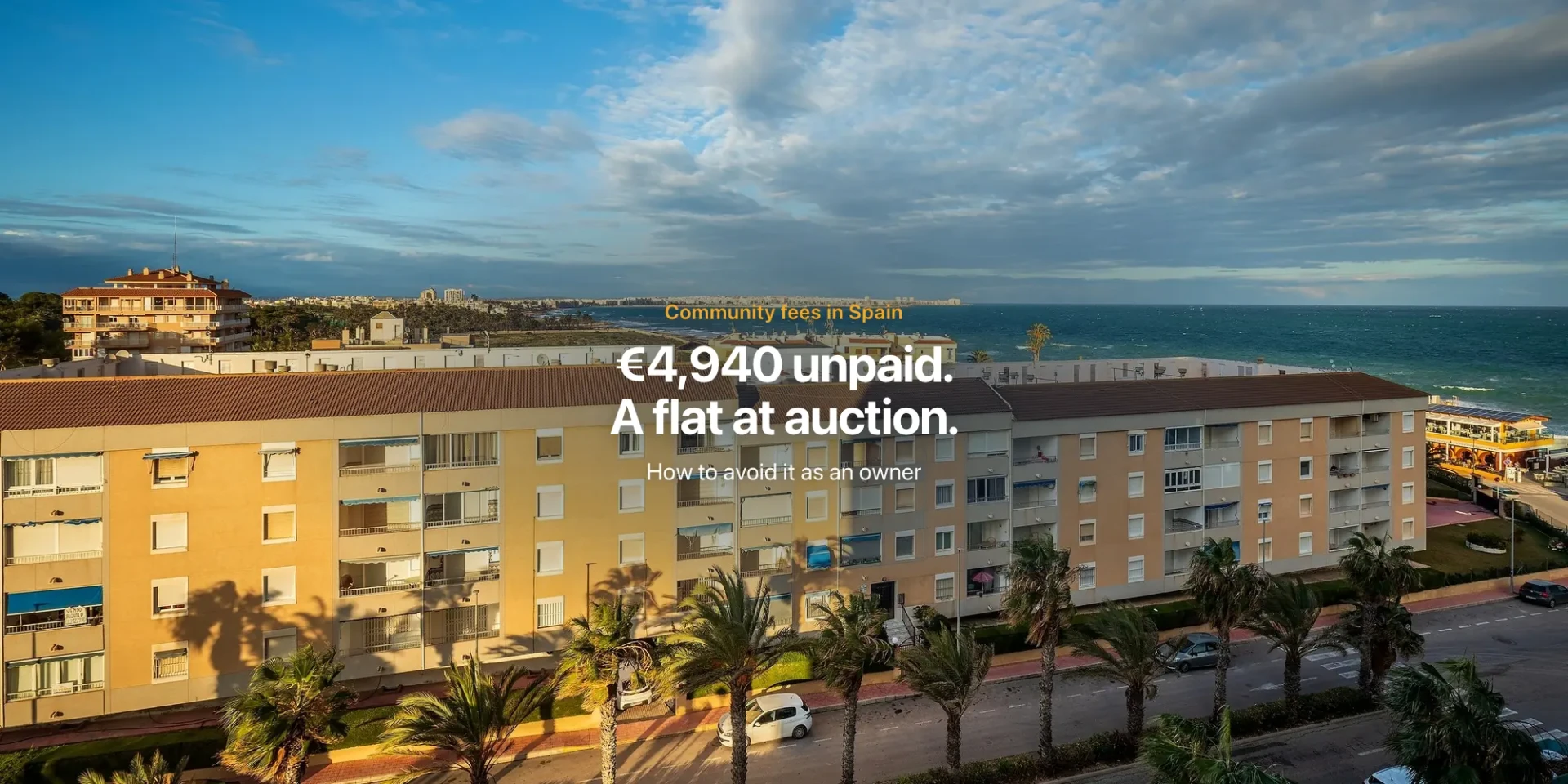
Community fees in Spain are what each owner pays towards the shared costs of a building or complex, often €30 to €150 a month on the Costa Blanca. Stop paying and the community can take you to court and force an auction. Buy without checking and the seller's arrears can follow the property to you.

What are community fees in Spain?
Every building or complex split into separate homes has a community of owners, the comunidad de propietarios. Its rules come from the Ley de Propiedad Horizontal, the Spanish law on shared ownership.
The community pays for everything you share: the pool, gardens, cleaning, lifts, lighting, building insurance and the administrator. Your slice depends on your ownership share, called the cuota de participación, which is fixed in the property's title.
Two rules surprise British buyers:
- Not using something does not excuse you from paying for it. If you are in the UK for most of the year, you still pay your full share of the pool.
- There must be a reserve fund. By law it can never be less than 10 per cent of the last ordinary budget.
How much are community fees on the Costa Blanca?
We found no official average for the Costa Blanca, so the table below uses ranges from two agency guides to the southern Costa Blanca published in 2026. Nationally, a Spanish consumer report put community costs at about €1,260 a year.
| Type of property | Typical fee per month |
|---|---|
| Simple block, no pool | €25 to €50 |
| Small complex, 10 to 30 homes | €30 to €60 |
| Large complex with pool, gym and gardens | €60 to €120 |
| Resort-style urbanisation with pool and gardens | €60 to €150 |
| Very large complex with many facilities | €150 to €250 |
| Gated luxury development | Above €300 |
| Detached villa with no community | €0, but all upkeep is yours |
These are published estimates rather than official statistics, so always get the real figure for the exact property.
Ask for it in writing, alongside the community's budget.
What happens if you don't pay community fees in Spain?
The community does not have to wait long or hire an expensive law firm. The route from arrears to auction looks like this:
- The debt is approved and you are notified. The community certifies the amount owed and tells you. That notice can be posted on the community noticeboard for at least three days if it cannot reach you.
- An attempt to settle. Since 3 April 2025 Spanish civil claims generally need a genuine attempt at negotiation first, and community debt is treated as included. If you get an offer to settle, answer it.
- The court payment order (monitorio). The community can file without a lawyer. You get 20 days to pay or to file a reasoned objection. Do nothing and the case moves to enforcement.
- Seizure and auction. The property can be seized and sold on the government's online auction site, Subastas BOE.
This is not a theoretical risk. In October 2026 Spanish media reported a four-bedroom flat in Málaga, valued at €430,893, going to auction over €4,940 in unpaid fees, plus €1,500 budgeted for interest and costs.
The debt also grows. Interest runs from the day each payment was due. If the community uses a lawyer and court agent for the claim, you pay those fees too, within legal limits.
There are smaller penalties as well. Owners can vote for measures such as a temporary ban from the pool. Anyone in arrears cannot vote at meetings, and their name goes on the debtors' list sent out with the meeting notice.
Why are owners living in the UK most at risk?
This is the trap for anyone who lives abroad. The law asks every owner to give the community an address in Spain for notices. If you don't, notices go to the property itself. If nobody is there to receive them, the community can pin the notice to the noticeboard. After three calendar days it has full legal effect, even if you are at home in Manchester and know nothing about it.

Votes work in a similar way. In most decisions, an absent owner who was properly notified has 30 calendar days to object. Stay silent and your vote counts as a yes. That is how one-off charges can be approved without you.
British owners also spend long stretches away by law: the Schengen rule allows up to 90 days in any 180. So set things up to run without you:
- Give the administrator a real Spanish address, where someone actually collects post, plus your email. A lawyer, a gestor or a trusted friend can work.
- Pay by direct debit (domiciliación bancaria) from a Spanish account, and keep euros in it. A sterling account elsewhere will not help if the Spanish one runs dry.
- Read the minutes of every meeting.
- Send a proxy to meetings. The law accepts a simple letter signed by you.
Do you inherit the previous owner's debts when you buy?
Up to a limit, yes. This is the key point for a buyer. Spanish law makes the property itself answer for the previous owner's unpaid fees for the part of the current year already due plus the three previous calendar years. That applies even after your title is registered.
Say the fee is €100 a month and you complete at the end of October 2026. In the worst case the property could answer for 46 months, or €4,600. That is our own illustration, and it shows why this check matters.
The protection is a certificate of debts from the community. The seller must produce it at the notary. It is issued by the community's secretary, in practice usually the administrator, with the president's approval, within seven calendar days of the request. The notary cannot authorise the deed without it, unless the buyer expressly waives it. Never waive it.
What should you check beyond the debt certificate?
A clean certificate does not tell you everything. Ask for these before you commit:
| Check | Why it matters |
|---|---|
| Minutes of recent meetings | Show any approved one-off charge (derrama) and any disputes |
| Budget and the exact fee | Confirms what you will really pay each year |
| Planned building works | Works agreed now can be billed after you buy |
| Reserve fund balance | A thin fund makes one-off charges more likely |
| Rules on holiday lets | New short-term lets need a three-fifths vote of owners, in force since 3 April 2025 |
One-off charges. A derrama for a new roof or pool may be approved before you buy and fall due afterwards, so it may not appear as a debt on the certificate. For improvements, the law says the bill goes to whoever owns the property when each payment falls due. Spanish legal commentary warns that a buyer usually ends up exposed, and suggests deducting the amount from the price or holding it back until the seller pays. Put that in the contract.
Accessibility works. Ley 4/2026, in force since 23 October 2026, strengthened the duty to carry out accessibility works such as ramps and lifts. They are compulsory when an owner asks on behalf of a resident with a disability or aged over 70, if the yearly cost per owner after grants stays within 12 months of ordinary fees. They also become compulsory when grants reach 70 per cent of the cost. In an older block with no lift, ask whether anything is planned.
We help you get the certificate and the minutes into the file before you sign, and we keep an eye on the deadlines. If you are still weighing up your options, our guide to new build versus resale in Spain explains how the risks differ, and our checklist of things to know before buying covers the wider process. Very low asking prices deserve extra care, as we explain in the risks of cheap property in Spain. Remember the bigger picture too: buying costs run up to 13 to 14 per cent on top of the listing price, as our guide to the 9 per cent ITP purchase tax sets out.
Who runs a comunidad de propietarios?
Most Costa Blanca complexes hire a professional administrator, the administrador de fincas, who handles accounts, collects fees, arranges repairs and prepares meetings. Unless the community decides otherwise, those duties fall to the elected president.
In Alicante province, professional administrators can belong to the COAFA college, which has a public search by town. It is a quick way to check who you are dealing with. A well-run community also protects you in other ways, as we explain in our guide to squatters in Spain.
Frequently asked questions
What do community fees cover in Spain? Community fees cover the shared running costs of a building or complex. That usually means the pool, gardens, cleaning, lifts, lighting, building insurance and the administrator. Part goes into a reserve fund of at least 10 per cent of the last ordinary budget. Your share is set in the property's title.
How much are community fees in Spain? It depends on the building. Agency guides to the southern Costa Blanca put most apartments between €30 and €150 a month in 2026, with gated luxury developments above €300. A national consumer report suggests about €1,260 a year. Always ask for the exact fee on the property you want.
Do you have to pay community fees if you don't use the pool? Yes. Spanish law says that not using a service does not release you from paying for it. An owner who never swims, or who spends most of the year in the UK, still pays. Your bill follows your ownership share in the community, not how often you use the facilities.
Are you liable for unpaid community fees when you buy in Spain? The property answers for the seller's unpaid fees for the part of the current year already due plus the three previous calendar years. To protect yourself, get the community's debt certificate before signing. The notary needs it unless you waive it, and you should never waive it.
What happens if you don't pay community fees in Spain? The community can certify the debt and, after an attempt to settle, apply to court for a payment order. You then have 20 days to pay or object. If you do nothing, the property can be seized and auctioned online. Interest and legal costs are added to what you owe.
Who pays a derrama when a property is sold in Spain? For improvements, the law says it falls on whoever owns the property when each payment becomes due. So a charge approved before you buy can land on you. Read the meeting minutes first, then agree in the contract who pays, or deduct the amount from the price before you sign.
Buying on the Costa Blanca?
A good community makes owning from the UK easy, and a poor one can cost you for years. We'll talk you through the fees and paperwork on any property you like, from our offices in Torrevieja and Calpe, in English from the first call to the notary. Browse homes for sale in Torrevieja to get a feel for what's available. We are a licensed agency, RAICV 4221, and we work with lawyers and banks. Our clients don't pay us commission.
Prefer to talk? Call us on +44 20 3888 0008.
Sources
- BOE, Ley 49/1960 de Propiedad Horizontal, consolidated text, articles 7, 9, 13, 15, 16, 17, 20 and 21 (official): boe.es
- BOE, Ley 1/2000 de Enjuiciamiento Civil, consolidated text, articles 814 to 816 (official): boe.es
- BOE, Ley Orgánica 1/2025, article 5 on negotiation before court (official): boe.es
- BOE, Ley 4/2026 of 1 October, first final provision (official): boe.es
- Portal de Subastas, Agencia Estatal BOE (official): subastas.boe.es
- GOV.UK, Spain entry requirements, 90 days in any 180 (official): gov.uk
- Colegio de Administradores de Fincas de Alicante (COAFA), search by town: coafa.es
- Consejo General de Colegios de Administradores de Fincas, 1 December 2025, negotiation step and community debts: cgcafe.org
- El Español Málaga, 12 October 2026, flat at auction over community debt: elespanol.com
- Euro Weekly News, 13 October 2026: euroweeklynews.com
- El Español, 6 June 2026, one-off charges and buyers: elespanol.com
- OceanHome, community fees guide, April 2026: oceanhome.es
- MOVR, annual costs on the south Costa Blanca, 5 June 2026: movr.es
- Europa Press via Bolsamanía, 5 February 2026, Roams consumer spending report: bolsamania.com
Last checked: October 2026