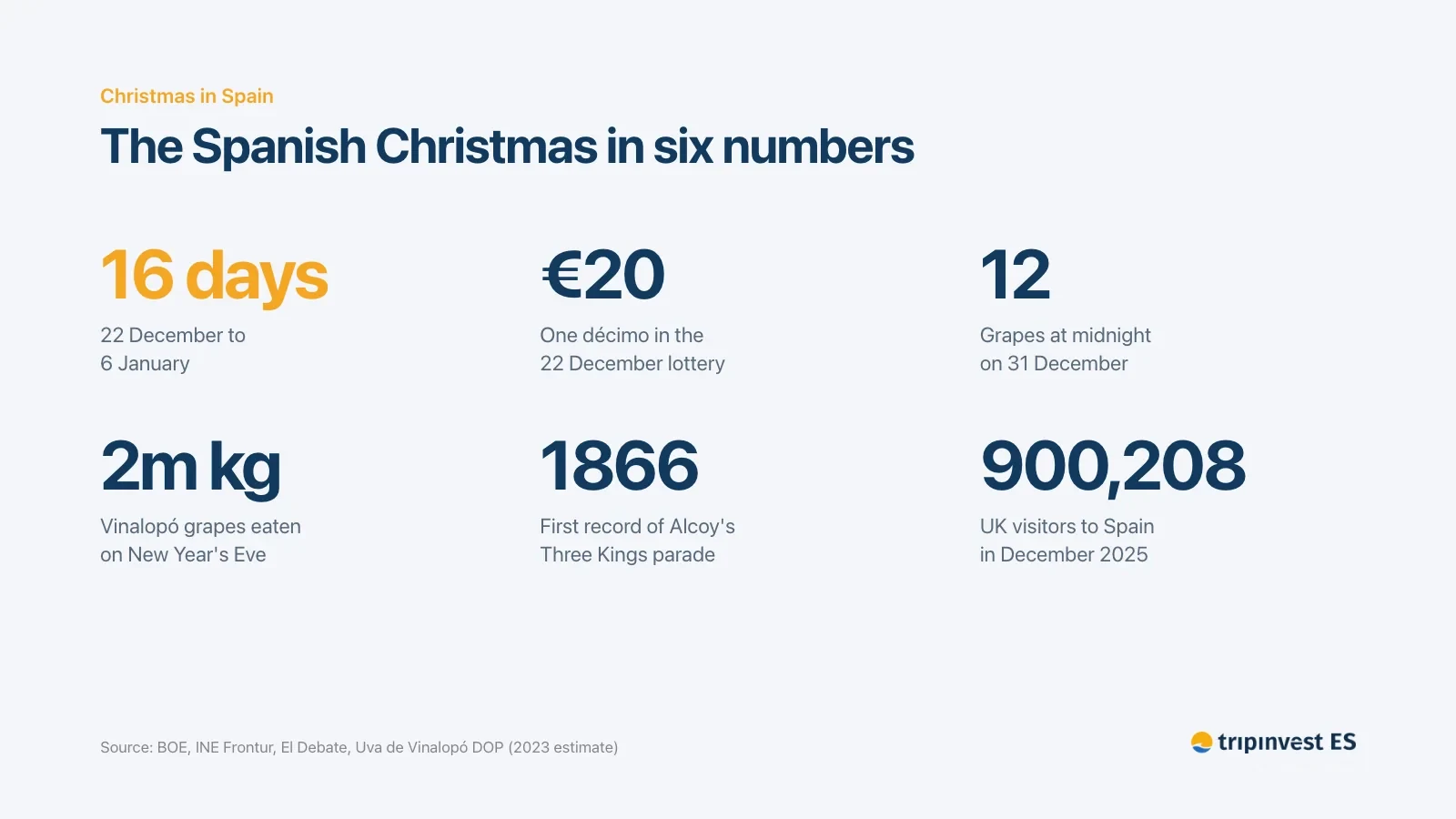
Christmas in Spain runs from the lottery draw on 22 December to Three Kings on 6 January. Families celebrate most on Christmas Eve, people eat 12 grapes at midnight on New Year's Eve, and children traditionally wait for the Kings to bring their main presents. On the Costa Blanca, 26 December is an ordinary day.
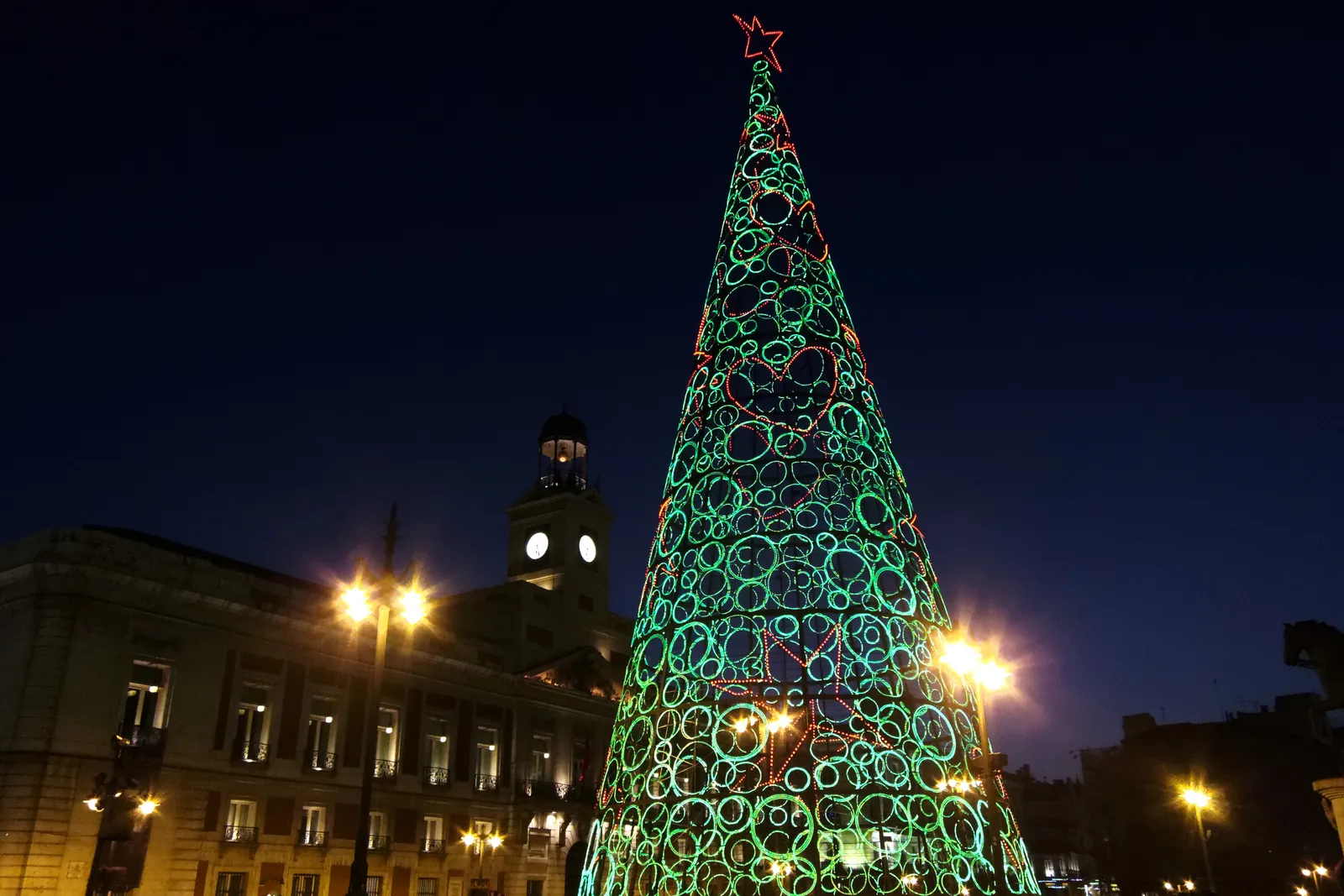
This guide goes date by date through what Spanish families do, with the Costa Blanca detail most guides miss: two of Spain's best-known Christmas foods come from Alicante province. For weather and where to go, read our guide to a warm Christmas in southern Spain.
When does Christmas start and end in Spain?
Towns have lights and markets up by early December, but the family calendar runs from 22 December to 6 January. These are this season's dates, with public holidays from Spain's official list. Each town can add up to two local holidays.
| Date | Name | What happens | Holiday on the Costa Blanca? |
|---|---|---|---|
| Tuesday 22 December 2026 | Lotería de Navidad | The Christmas lottery draw, live all morning | No |
| Thursday 24 December | Nochebuena | Big family dinner, the King's message, midnight Mass | No |
| Friday 25 December | Navidad | Long family lunch | Yes |
| Saturday 26 December | San Esteban | Ordinary day here, holiday in Catalonia and the Balearics | No |
| Monday 28 December | Santos Inocentes | Spain's April Fools' Day | No |
| Thursday 31 December | Nochevieja | Late dinner, 12 grapes at midnight, cava | No |
| Friday 1 January 2027 | Año Nuevo | Family lunch | Yes |
| Tuesday 5 January | Cabalgata de Reyes | Three Kings parades in the evening | No |
| Wednesday 6 January | Día de Reyes | Presents, then roscón cake | Yes |
There is an early warm-up too. Constitution Day falls on Sunday 6 December this year, and Tuesday 8 December is a national holiday. Andalusia and Murcia take Monday 7 December off. The Comunitat Valenciana, which includes the Costa Blanca, does not.
What happens in Spain on 22 December?
The real start is the Christmas lottery. Children from Madrid's San Ildefonso school sing out the numbers on live television from about 9:00, and you will hear it in bars, kitchens and offices all morning.
A €20 share of a ticket, the décimo, pays €400,000 before tax if it carries the top number. Families and colleagues often buy the same number, so nobody misses out.
What are the Christmas Eve traditions in Spain?
Nochebuena, "the good night", is the main event for most families. The meal is long, with many small starters: jamón, local cheese and prawns. Fish, seafood or roast lamb follow, then a tray of sweets. The King's Christmas message goes out on television, usually at 21:00.
After dinner, some people go to La Misa del Gallo, the midnight Mass, where carols called villancicos are sung. The key decoration is the belén, a nativity scene, from a few figures on a sideboard to huge displays in town squares.
What do Spanish people eat at Christmas?
Spain has no single Christmas dinner in the way Britain has turkey. Each region has its own.
| Food | When | Where |
|---|---|---|
| Prawns, jamón and cheese | Starters at many Christmas meals | Across Spain |
| Lamb with ajoaceite (garlic sauce), fish or shellfish | 24 December | Comunitat Valenciana |
| Putxero de Nadal, a stew with meatballs called pelotas | 25 December | Comunitat Valenciana |
| Baked sea bream (besugo) | Christmas meals | Madrid and the Basque Country |
| Roast suckling pig (cochinillo) | Christmas Eve | Castile and León |
| Seafood platter (mariscada) | Christmas meals | Galicia, Cantabria, Asturias |
| Escudella broth with galets pasta shells | Christmas meals | Catalonia |
| Turrón, almond nougat | All season | Sold everywhere, protected types from Xixona |
| Crumbly mantecados and polvorones | All season | Often from Estepa, Andalusia |
| Roscón de Reyes, a ring cake | 6 January | Across Spain |
Cava is the usual toast. Cider, anise liqueur and sweet muscat wine also appear, depending on the region.
On the Costa Blanca, putxero is the dish to try. Every cook has a different recipe, and the leftovers traditionally became new dishes on 26 December.
Why is Xixona so important for Spanish Christmas sweets?
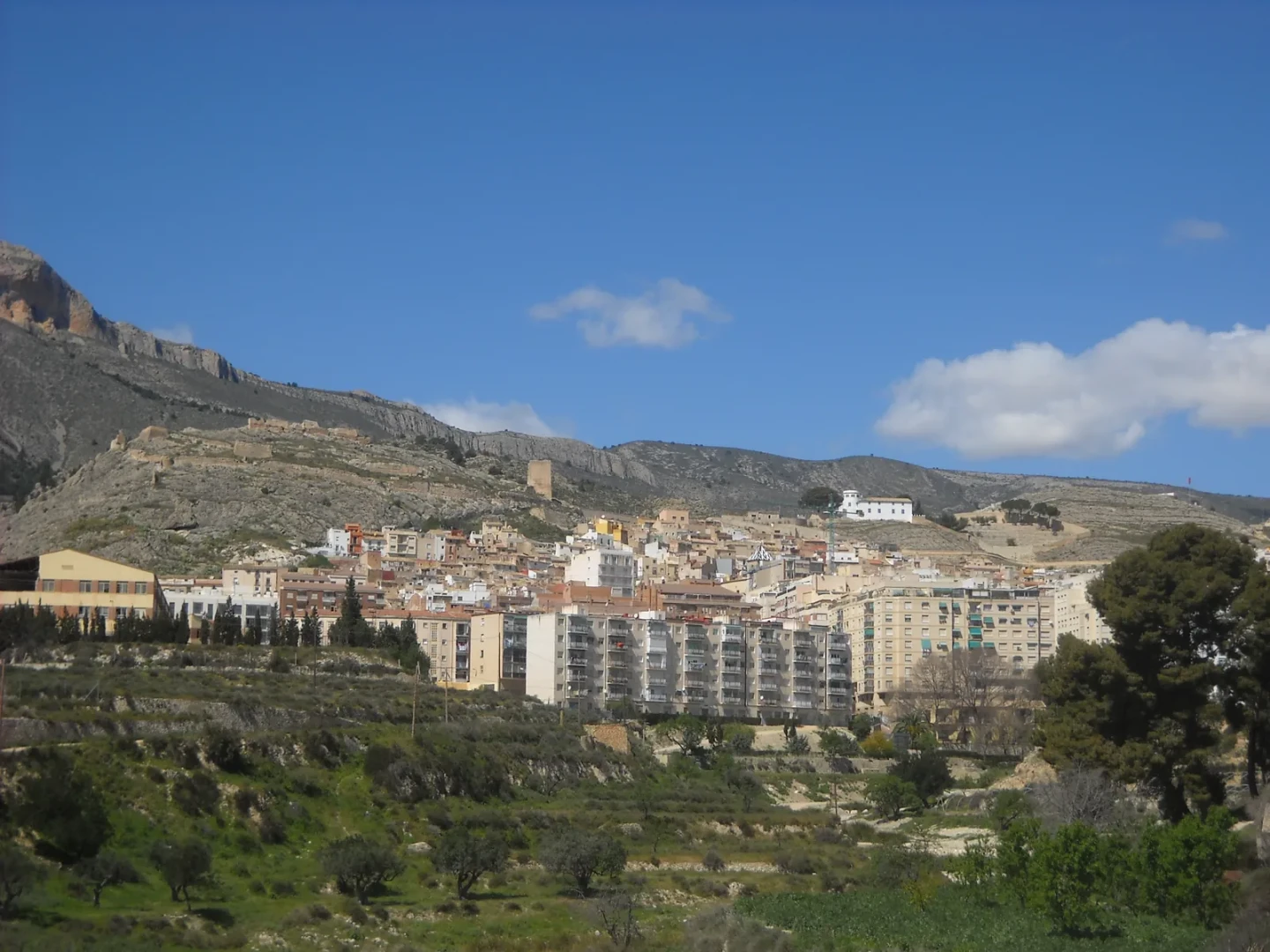
Turrón is the sweet most tied to this coast. Its home is Xixona (Jijona), a hill town inland from Alicante, where the two EU-protected types are made: soft Jijona and crunchy Alicante.
What happens in Spain after Christmas Day?
If you're in Catalonia or the Balearic Islands, the holidays continue with St Stephen's Day (26 December), an official holiday in both regions in 2026. In 2027 it falls on a Sunday and is on neither region's list of holidays. Everywhere else, the Costa Blanca included, it is not a public holiday, so forget Boxing Day.
On 28 December comes Día de los Santos Inocentes, when Spaniards play pranks on each other. In Ibi, inland Alicante, it turns into Els Enfarinats. A group in mock military dress takes over the town and fines people under absurd laws, then fights a rival group with flour, eggs and firecrackers. The fines go to local charities. The tradition goes back to at least 1862.
Why do Spanish people eat 12 grapes at New Year?
At midnight on 31 December, Spaniards eat one grape for each of 12 chimes, for luck in the 12 months ahead. Many follow the broadcast from Puerta del Sol in Madrid, which Spanish television has shown since 1962.
Two tips if it is your first time. The real chimes, the campanadas, come after four preliminary quarter chimes, the cuartos. Starting on those marks you out as a foreigner. And if you are a slow eater, supermarkets sell packs of 12, some peeled and deseeded.
Nobody fully agrees on the origin. A popular story blames a grape surplus in 1909, but press references from the late 19th century point to wealthy Madrid families copying a French habit.
The grapes have a Costa Blanca link as well. The Vinalopó valley in Alicante province grows table grapes inside paper bags on the vine, which gives the Aledo variety a thin skin. Aledo is the classic New Year's Eve grape. In 2023 the valley's protected-origin body estimated about 2 million kilos of its grapes would be eaten that night.
After the grapes comes a cava toast, then cotillón parties with paper hats and noisemakers. Many people wear red underwear for luck.
How do the Three Kings work in Spain?
For children, this is the big one. Traditionally the Kings bring the main presents, not Father Christmas. Papá Noel is becoming more common, and many families now divide presents between 25 December and 6 January.
On the evening of 5 January, towns hold a cabalgata, a parade of floats, and the Kings throw sweets to the crowd. Some people hold umbrellas upside down to catch them. At home, children leave out their shoes, treats for the Kings and hay for the camels. Those who have been naughty are told to expect a lump of coal.
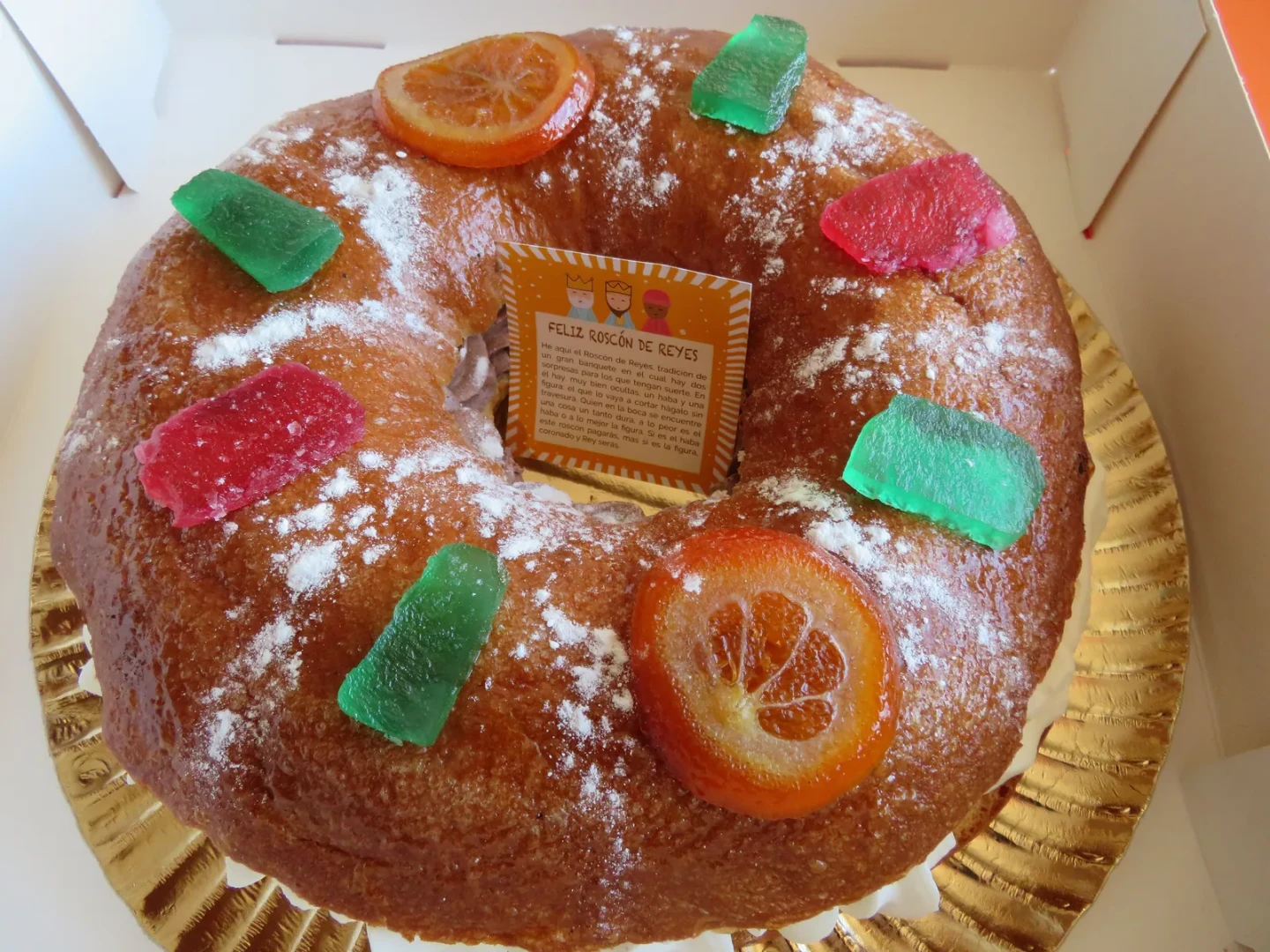
On 6 January, a public holiday, families open presents and share roscón de Reyes. It hides a figurine and a dried bean. Find the figurine and you are king or queen for the day. Find the bean and you buy next year's cake.
Where is the oldest Three Kings parade in Spain?
In Alcoy, in Alicante province. The regional decree that protects it calls it the oldest in Spain, first recorded in 1866 and in its present form from 1885. At dusk on 4 January a royal envoy rides through the streets, followed by donkeys carrying postboxes for children's letters. On 5 January the Kings' pages climb wooden ladders to balconies to hand over presents. Alcoy also stages the Betlem de Tirisiti, a rod-puppet nativity show from the late 19th century.
The coast has its parades too, and rain can change them. In January 2026 Torrevieja moved its parade from 5 January to 6 January at 17:00 because of the forecast. The route ran along Ramón Gallud, the street of our Torrevieja office, to Plaza de la Constitución.
How do other parts of Spain celebrate Christmas?
- Catalonia: From 8 December children feed the Tió de Nadal, a wooden log under a blanket. At Christmas they hit it with sticks while singing, and it "delivers" sweets. Nativity scenes also hide the caganer, a crouching peasant figure.
- Basque Country: Olentzero brings presents on the night of 24 December.
- Jerez de la Frontera: Zambombas are Christmas gatherings with flamenco songs, food and wine. They became protected cultural heritage in 2015.
For the rest of the year, see our calendar of the best Spanish festivals and our guide to Easter traditions in southern Spain.
What should British visitors know about Christmas in Spain?
It is a lovely season, but not a British Christmas. Some honest minuses:
- Shops shut. In 2025 Mercadona closed at 19:00 on 24 and 31 December, two and a half hours early. It generally closes on public holidays, so stock up first.
- Set menus are not cheap. On one Alicante listing, Christmas 2025 menus ran from about €37 to €88 a head. Book early.
- Markets are small. Do not expect a German-style Christmas market. The best known are Madrid's Plaza Mayor and Barcelona's Fira de Santa Llúcia.
- Christmas Eve is a night in. Your first one here may feel quiet unless you have friends nearby.
- Your 90 days still count. On a British passport you can stay up to 90 days in any 180, and the count does not reset on 1 January. You may also have fingerprints and a photo taken at the border under the EU's Entry/Exit System. Irish citizens, as EU citizens, are not covered by the 90-day rule. If one winter makes you want more, read our guide to life in Spain.
You will have company. Spain received a record 96.8 million international tourists in 2025 on INE's provisional figures, and the UK was the top market that December, with 900,208 visitors.
Frequently asked questions
Do Spanish people celebrate Christmas on 24 or 25 December?
Both, but Christmas Eve, called Nochebuena, is usually the bigger night. Families share a long dinner on 24 December and some go to midnight Mass. Christmas Day is a national public holiday with another long family lunch, which on the Costa Blanca is often a stew called putxero de Nadal.
Does Santa come to Spain?
Father Christmas, or Papá Noel, is becoming more common in Spain, but the Three Kings are the traditional gift-bringers. Children wake to presents on 6 January, and many families now split gifts between the two dates. In the Basque Country, Olentzero visits instead on the night of 24 December.
What is the traditional Spanish Christmas dinner?
There is no single national dish. Many tables start with jamón, cheese and prawns, then move on to regional mains such as sea bream in Madrid, suckling pig in Castile, seafood in Galicia and lamb or fish around Valencia. Turrón and other sweets finish the meal, usually with cava.
Is Boxing Day a holiday in Spain?
No, Spain has no Boxing Day. St Stephen's Day on 26 December is a public holiday in Catalonia and the Balearic Islands in 2026, but in 2027 it falls on a Sunday and is on neither list. On the Costa Blanca it is an ordinary day.
Are shops open on Christmas Day in Spain?
Mostly not. 25 December, 1 January and 6 January are public holidays across Spain, and supermarkets such as Mercadona generally close. In 2025 Mercadona also shut early, at 19:00, on 24 and 31 December. Some restaurants do open with set menus, so book ahead and buy food in advance.
How do you say Merry Christmas in Spain?
Feliz Navidad is the greeting across most of Spain, and Feliz Año Nuevo covers New Year. You will also hear Bon Nadal in Catalonia, Bo Nadal in Galicia and Eguberri on in the Basque Country. Christmas itself is la Navidad, and the whole season is las Navidades.
Thinking of spending Christmas in your own place in Spain?
If a winter trip has you comparing towns, start with our guide to where to live in Spain and our Torrevieja town guide, then look at homes for sale in Torrevieja. Banks and public offices close on the public holidays above, so a purchase timed around Christmas needs planning.
Tripinvest ES is a licensed agency (RAICV 4221), and you get service in English from the first call to the notary. We help you through the paperwork and we keep an eye on deadlines. Our clients don't pay us commission. Call us on +44 20 3888 0008 or send us a message.
Sources
Last checked: October 2026
- BOE: national and regional holidays for 2026, published 28 October 2025
- BOE: national and regional holidays for 2027, published 13 October 2026
- BOE: Decreto 199/2011 protecting the Alcoy Three Kings parade
- INE: Frontur, international tourists, December 2025
- GOV.UK: entry requirements for Spain
- Comunitat Valenciana tourism board: Christmas traditions
- Comunitat Valenciana tourism board: Betlem de Tirisiti
- Ayuntamiento de Torrevieja: Three Kings parade postponed, 4 January 2026
- ICEX Foods and Wines from Spain: Jijona PGI
- Tourism Euskadi: Olentzero and Mari Domingi
- Andalucía tourism board: the zambombas of Jerez
- El Debate: Christmas lottery prizes 2026, 14 October 2026
- El Debate: Mercadona's December hours, 1 December 2025
- El Español: Christmas lottery 2026 date and time
- El Español: Christmas traditions in Alicante province, 25 December 2025
- Alicante Plaza: Vinalopó grapes on New Year's Eve, 26 December 2023
- Alicante Plaza: Els Enfarinats in Ibi, 28 December 2018
- Alicante Plaza: Betlem de Tirisiti season, 19 November 2025
- Directo al Paladar: why Vinalopó grapes grow in bags
- Público: the origin of the New Year grapes
- The Objective: the King's Christmas message, 24 December 2023
- The Local: Els Enfarinats in Ibi, 28 December 2022
- Catalan News: the Tió de Nadal and the caganer
- idealista: traditional Spanish Christmas food
- idealista: Spanish Christmas traditions
- Saga: Christmas in Spain, 27 November 2025
- The Spanish Eye: New Year's Eve traditions, 31 December 2025
- andalucia.com: Three Kings in Spain
- Murcia Today: the Three Kings on 6 January
- Salir.com: restaurants open at Christmas in Alicante
- Wikipedia (Spanish): the lucky grapes