Healthcare in Spain for expats: public, private and schools
Healthcare in Spain for expats is free at the point of use only if you are covered. Living here is not enough. Britons usually qualify through work, a UK S1 form, the Convenio Especial or permanent residency. Everyone else needs private insurance, which gets expensive in your sixties.
This guide is for people moving to Spain. UK visitors use a UK GHIC or EHIC instead.
How do expats get public healthcare in Spain?
Registering as a resident does not give you access on its own. You need one of these routes.
| Your situation | Route | What you pay | The catch |
|---|---|---|---|
| Working or self-employed in Spain | Social security | Your contributions, plus part of each prescription | Dependants register separately with the INSS, the social security office |
| Drawing a UK State Pension or exportable benefit | UK S1 form | Part of each prescription | You must register the S1 with the INSS |
| Dependant of a UK State Pensioner | The pensioner's S1 | Part of each prescription | Ends when you claim your own State Pension, then you get a new S1 |
| Five years' residence | Permanent residency | Part of each prescription | You need a letter from NHS Overseas Healthcare Services, and it is closed if the UK pays through an S1 |
| About a year here, not working | Convenio Especial | €60 or €157 a month, plus the full price of prescriptions | Closed if the UK pays through an S1 |
| No route yet, usually your first year | Private insurance | A monthly premium | Rises steeply with age |
The trap for early retirees is the gap. The pensioner S1 starts with the State Pension, so if you move at 58 you may pay for your own cover for years. See our guides to retiring to Spain from the UK and how to become a Spanish resident.
GOV.UK also warns that you may lose free NHS treatment if you move abroad permanently, and that travel insurance is not meant to cover healthcare once you live abroad.
Irish citizens need no visa. To stay beyond three months you must apply to register within three months of arriving, with a job, or with comprehensive health insurance and enough resources.
How do you register with an S1 and get a SIP card?
The SIP card is the public health card in the Valencian region, and it also works in the rest of Spain. Here is the usual order for a UK pensioner.
- Request your S1 by phone from NHS Overseas Healthcare Services, +44 191 218 1999.
- Register on the padrón at your town hall and register as a resident.
- Register the S1 with the INSS, at a local office or through its online portal. The INSS then posts you a Spanish social security number.
- Take your NIE, that INSS document and your padrón certificate (ideally under six months old) to your nearest health centre.
- The centre issues the card. There is also a virtual version in the GVA+Salut app.
If registering the S1 is delayed and you need urgent treatment, ring Overseas Healthcare Services. The regional 012 helpline is on +34 96 386 60 00, Monday to Friday.
Once you have the card, your health centre is the way in. Your family doctor refers you to a hospital or specialist. In an emergency, dial 112 and ask for an ambulance, or go straight to Urgencias at a public hospital, with no referral.
What is the Convenio Especial and is it worth it?
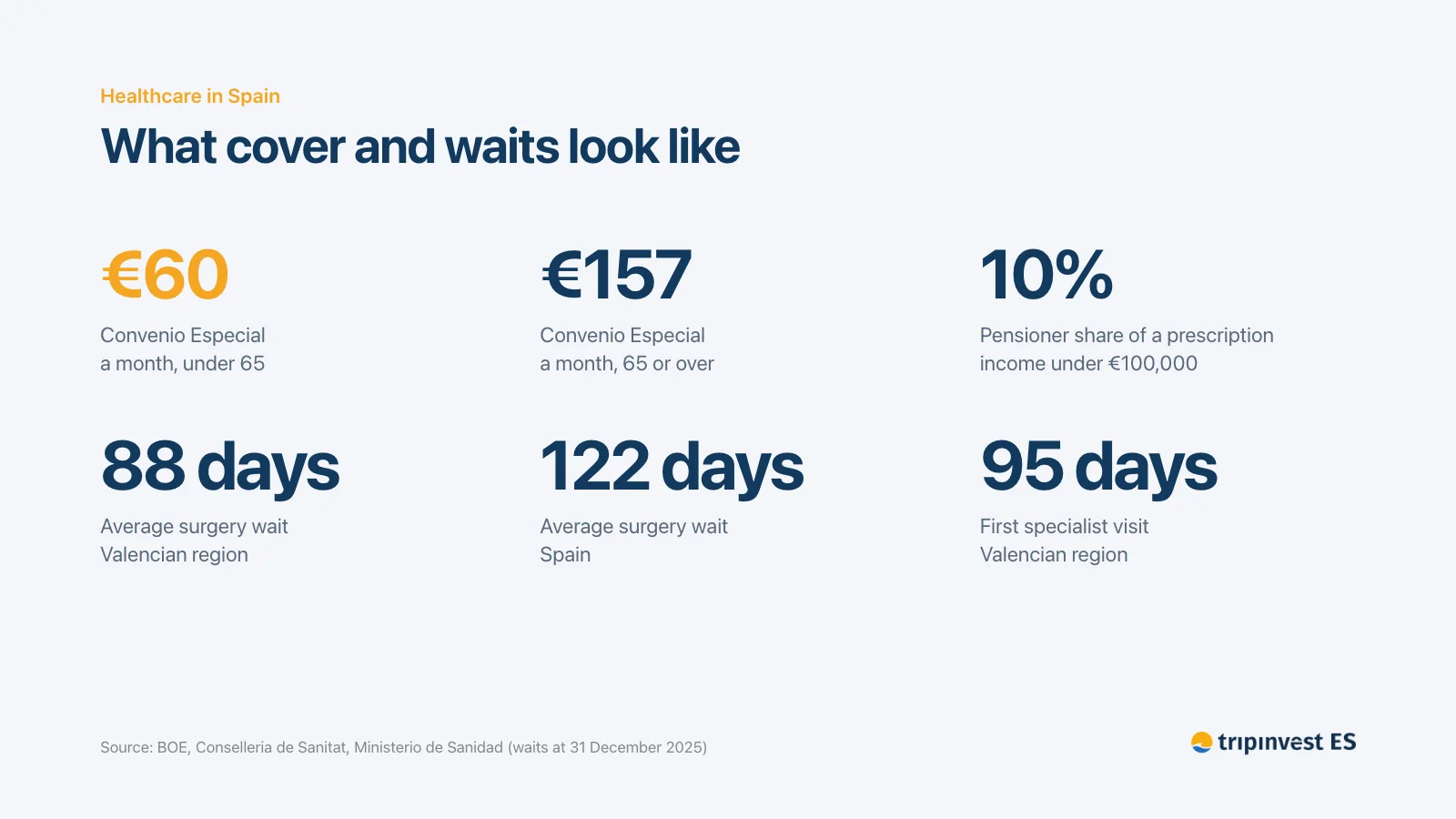
It is a pay-in scheme for people with no other public route. In the Valencian region it costs €60 a month under 65 and €157 a month from 65. It is cheap next to insurance, with three catches.
- No medicines. It does not cover pharmacy costs, so you pay full price for prescriptions, plus prostheses, orthopaedic supplies and non-urgent transport.
- You must wait. You need a year of residence and the padrón. GOV.UK says a year on the padrón. The Valencian page counts a continuous year's residence in Spain, the EU or the UK just before you apply, so ask 012 which applies to you.
- You apply online. The Valencian application needs a digital certificate or Cl@ve, so sort that out first.
How much does private health insurance cost in Spain?
Expatica puts typical cover at €50 to €200 a month, which is low for buyers in their sixties. One example from Sanitas: April 2026 first-year list prices for one new customer in its rest of Spain band, as Alicante province has no band of its own.
| Age | Más Salud, no co-payment, a month | Residents Visado, visa policy, a month |
|---|---|---|
| 50 to 54 | €111.67 | €135.92 |
| 60 to 64 | €175.93 | €212.08 |
| 65 to 69 | €201.31 | Closed to new joiners |
For a couple aged 60 to 64:
| Route | Cost for two, a month | Cost for two, a year |
|---|---|---|
| Convenio Especial, both under 65 | €120 | €1,440 |
| Sanitas Más Salud, no co-payment, two people | €325.80 | €3,909.60 |
| Sanitas visa policy, two people | €397.56 | €4,770.72 |
An S1 adds no premium once you qualify, but a couple this age would not normally have one yet.
What does a non-lucrative visa policy need?
A travel policy will not do. The Spanish Consulate in London wants an insurer authorised in Spain covering every risk the public system covers, and also accepts proof of a registered S1. The Washington consulate adds no co-payment, no waiting period, no cover limit, a year's validity and cover for your whole stay. Check with your own consulate before you buy, and ask these questions.
- Joining age. Sanitas's April 2026 tariff caps new joiners at 64 on Residents Visado and 75 on Más Salud, with no age limit for staying on.
- Your health and nationality. Expect a full questionnaire, read how existing conditions are treated, and check Sanitas's nationality rule.
Where can you find English-speaking doctors on the Costa Blanca?
You may not find English at a public health centre, so take a Spanish speaker or a translation app to first appointments. The FCDO lists private providers with English-speaking staff, without recommending any of them. For Alicante province it includes:
- Alicante: Hospital Vithas Alicante, Hospital Vithas International Medimar
- Benidorm: HCB Benidorm (formerly Hospital Clínica Benidorm), IMED Levante
- Torrevieja: Hospital Quirónsalud Torrevieja, IMED Torrevieja polyclinic
- Dénia and Albir: Scandinavian International Clinics
- Alfaz del Pi and Benijófar: Medcare
Nothing is listed for Calpe or Orihuela Costa, so check travel times when you compare towns. Our guides on where to live in Spain and property in Torrevieja help with that.
What do prescriptions and dentists cost?
The prescription rules changed on 14 May 2026, so older guides are out of date. Your share depends on your income on your Spanish tax return and on your status as a pensioner or worker. S1 holders are covered on the same basis as a Spanish citizen, so ask your health centre which band is on your record.
| Who | Income a year | Your share | Monthly cap |
|---|---|---|---|
| Pensioner | Under €18,000 | 10 per cent | €8.23 |
| Pensioner | €18,000 to €59,999 | 10 per cent | €13.37 |
| Pensioner | €60,000 to €99,999 | 10 per cent | €18.52 |
| Pensioner | €100,000 or more | 60 per cent | €61.75 |
| Worker | Under €18,000 | 40 per cent | €8.23 under €9,000, €18.52 above |
| Worker | €18,000 to €59,999 | 45 per cent | €61.75 under €35,000, none above |
| Worker | €60,000 or more | 50 to 60 per cent | None |
Anything above a cap is refunded by the region at least every six months. The Valencian health service also runs its own help for pensioners and other groups, which you can check online with your SIP number.
Dentistry is the big gap. Public care covers acute problems, extractions and minor mouth surgery. For most adults, implants, dentures, root canal work, orthodontics and cosmetic work are excluded and fillings are not on the list, so budget for a private dentist.
How long are waiting times in Spain compared with the NHS?
In Spain the average wait for non-urgent surgery was 122 days in December 2025, and in England the median wait for consultant-led treatment was 12.2 weeks in August 2026. The two countries measure waits differently, so compare them with care: Spain's figure is a mean from joining the surgery list, England's a median from referral across all consultant-led care.
| Average wait at 31 December 2025 | Valencian region | Spain |
|---|---|---|
| Non-urgent surgery | 88 days | 122 days |
| Cataract surgery | 39 days | 68 days |
| Hip replacement | 81 days | 98 days |
| Waiting over six months | 16.1 per cent | 21.6 per cent |
| First specialist appointment | 95 days | 102 days |
For the wider picture, see how the Costa Blanca's health claims stand up.
How does the school system work for expats?
Compulsory education in Spain spans ten years, from age 6 to 16, and is free in state schools. It has two stages: Educación Primaria (6 to 12) and Educación Secundaria Obligatoria, or ESO (12 to 16). Educación Infantil (0 to 6) comes before it and is voluntary.
Students who want to go to university take the PAU (Prueba de Acceso a la Universidad), still often called Selectividad, an entrance examination that plays a similar role to the A-Levels in the UK.
On the Costa Blanca, language is the big question. In towns classed as mainly Spanish-speaking, such as Torrevieja and Orihuela, families choose Spanish or Valencian as the base language. In towns classed as Valencian-speaking, such as Calpe, Dénia and Jávea, it is set for each school and class from family preferences. Pupils arriving from a foreign system can ask to be exempt from grades in Valencian for that year and the next, though they still attend the lessons. In mainly Spanish-speaking towns the exemption has no time limit.

Which schools in Spain teach in English?
British and international schools are the main option. Foreign-curriculum schools must be authorised and entered on a public register. The school finder of the National Association of British Schools in Spain, NABSS, lists over 80 members.
- Costa Blanca members include: King's College (Alicante), Elian's British School (La Nucía), Sierra Bernia School (Alfaz del Pi), Xàbia International College, The Lady Elizabeth School (Benitachell), El Limonar International School Villamartín and Newton College (Elche).
- International schools on the Costa del Sol include: The British School of Málaga, The British International School of Marbella, Aloha College and Swans International School.
At The Lady Elizabeth School, 2026/27 tuition for new pupils runs from €889 a month in Year 1 to €1,473 in Year 11, over ten months, plus €1,650 to join, €1,100 a year to re-enrol and compulsory lunch from €159 a month. Our guide to life in Spain covers daily life beyond schools.
Frequently asked questions
Is healthcare free in Spain for expats?
Only if you are covered. Public care is free at the point of use for people in the system, through work, an S1, permanent residency or the paid Convenio Especial. Being on the padrón does not cover you on its own. Most people also pay part of each prescription.
Can I use an S1 if I retire before State Pension age?
Usually not. The pensioner S1 comes with a UK State Pension or an exportable benefit, so early retirees normally pay for private cover first. A dependant of a State Pensioner can be covered, but that ends when they claim their own pension and are sent a new S1.
Do expats need private health insurance in Spain?
You need it if no public route covers you, which is common in your first year. A non-lucrative visa also requires a full policy from an insurer authorised in Spain, though the London consulate accepts a registered S1. Pensioners with an S1 do not need a policy, though some may want shorter waits.
How much is private health insurance in Spain for expats?
Expatica puts typical cover at €50 to €200 a month, but age changes that. Sanitas's April 2026 list price for a no co-payment policy in Alicante province was €111.67 a month at 50 to 54 and €201.31 at 65 to 69. Visa policies cost more, at €212.08 at 60 to 64.
Can expat children go to state schools in Spain?
Yes. Basic education from 6 to 16 is compulsory and free for everyone. On the Costa Blanca, lessons are in Spanish or Valencian, depending on the town and school. Families in mainly Spanish-speaking towns such as Torrevieja choose the base language, while schools in Calpe or Jávea follow family preferences.
Choosing a town around a doctor and a school
Tell us who is moving, how old you are and which route you expect to use, and we will help you look at towns that fit. You can browse homes for sale in Torrevieja first. We work with lawyers and banks, and we guide you in English from the first call to the notary. We are a licensed agency, RAICV 4221, and our clients don't pay us commission. Call us on +44 20 3888 0008.
Sources
Last checked: October 2026
- GOV.UK: Healthcare in Spain, including the Balearic and Canary Islands
- GOV.UK: Living in Spain
- GOV.UK: Moving, living or retiring abroad
- FCDO: Spain list of medical facilities and practitioners
- FCDO: Spain travel advice, health
- Conselleria de Sanitat: SIP health card
- Conselleria de Sanitat: SIP card questions, including Convenio Especial fees
- Conselleria de Sanitat: Convenio Especial
- Conselleria de Sanitat: help with co-payments
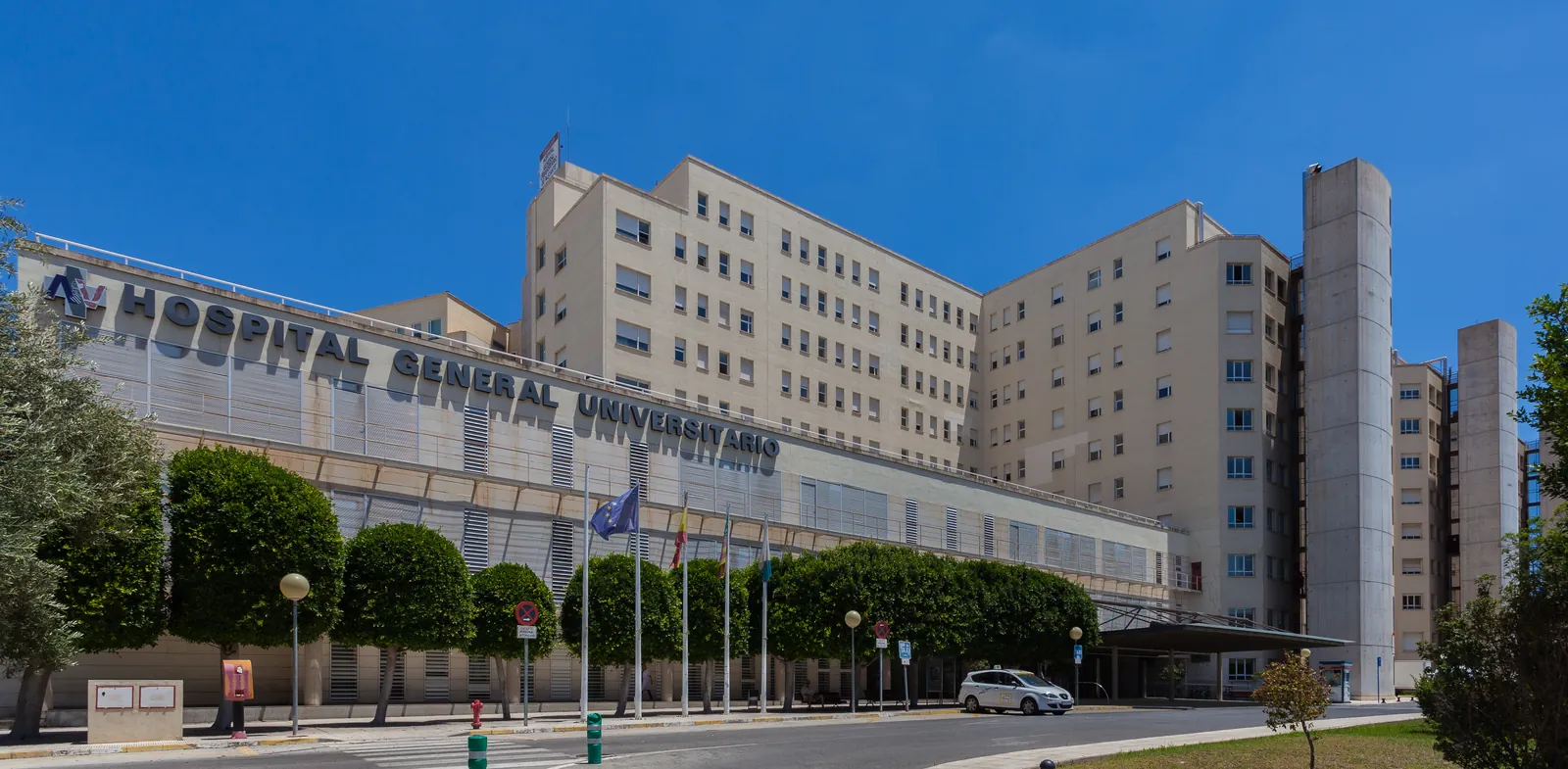
- Conselleria de Sanitat: Alicante health department, Hospital Doctor Balmis
- Ministerio de Sanidad: waiting lists in the national health system
- Ministerio de Sanidad: rectified regional data, December 2025
- Ministerio de Sanidad: rectified summary indicators, December 2025
- Ministerio de Sanidad: note on the December 2025 rectification
- NHS England: referral to treatment waiting times
- NHS England: RTT statistical press notice, August 2026
- BOE: Real Decreto Legislativo 1/2015, article 102 on prescription charges
- BOE: Real Decreto-ley 11/2026 on prescription charges
- BOE: Real Decreto 576/2013 on the Convenio Especial
- BOE: Real Decreto 240/2007, EU citizens and their families
- BOE: Real Decreto 1030/2006 on the common services portfolio, including dental care
- BOE: Ley Orgánica 2/2006 on education
- BOE: Real Decreto 534/2024 on university entrance
- BOE: Real Decreto 806/1993 on foreign schools in Spain
- BOE: Ley 4/1983 on the use and teaching of Valencian
- BOE: Ley 1/2024 on educational freedom in the Valencian region
- Spanish Consulate in London: non-lucrative residence visa
- Spanish Consulate in Washington: non-lucrative residence visa
- Your Europe: pensioners' residence rights
- Sanitas: April 2026 tariffs
- Sanitas: insurance prices
- Sanitas: health insurance for foreigners
- Expatica: Healthcare in Spain
- NABSS: member schools
- The Lady Elizabeth School: fees 2026/27 for new enrolments