
To check property ownership in Spain, order a nota simple from the Land Registry. It names the registered owner and lists the charges on the home. Then compare it with the seller's ID, the Catastro record, the latest IBI receipt and the community debt certificate. Do all this before you pay a deposit.
What proves who owns a property in Spain?
Spain keeps two property records, and buyers often mix them up. The Registro de la Propiedad, or Land Registry, records rights: who owns the home and what is charged against it. The Catastro describes the physical property for tax purposes.
Two papers from the seller cover what neither record shows.
| Document | Issued by | What it tells you | What it does not prove | Cost |
|---|---|---|---|---|
| Nota simple | Land Registry | Registered owner, description, mortgages and other charges | Who lives there, or whether fees are paid | About €9 plus VAT |
| Catastro record | Spain's cadastre | Location, size, use and plot map | Who owns it | Free online |
| IBI receipt | Town hall or its tax agency | That one year's property tax was paid | Ownership, or that older years are clear | From the seller |
| Community certificate | Community secretary, usually the administrator | Unpaid community fees | One-off charges not yet due | From the seller |
Spanish law presumes that a registered right belongs to the person shown. If you buy in good faith from that person and register your deed, you keep the home even if the seller's title later falls for a reason not on the register.
How do I get a nota simple online?
Use the official portal, sede.registradores.org.
- Find an identifier. The best is the IDUFIR or CRU, the property's unique registry number, so ask the seller or agent. Without it, the registrars' English service asks for the address and any other details that help identify the home.
- Choose the request. Under Propiedad, select Nota simple.
- State your interest. Registers are open to people with a known interest, and planning to buy is enough.
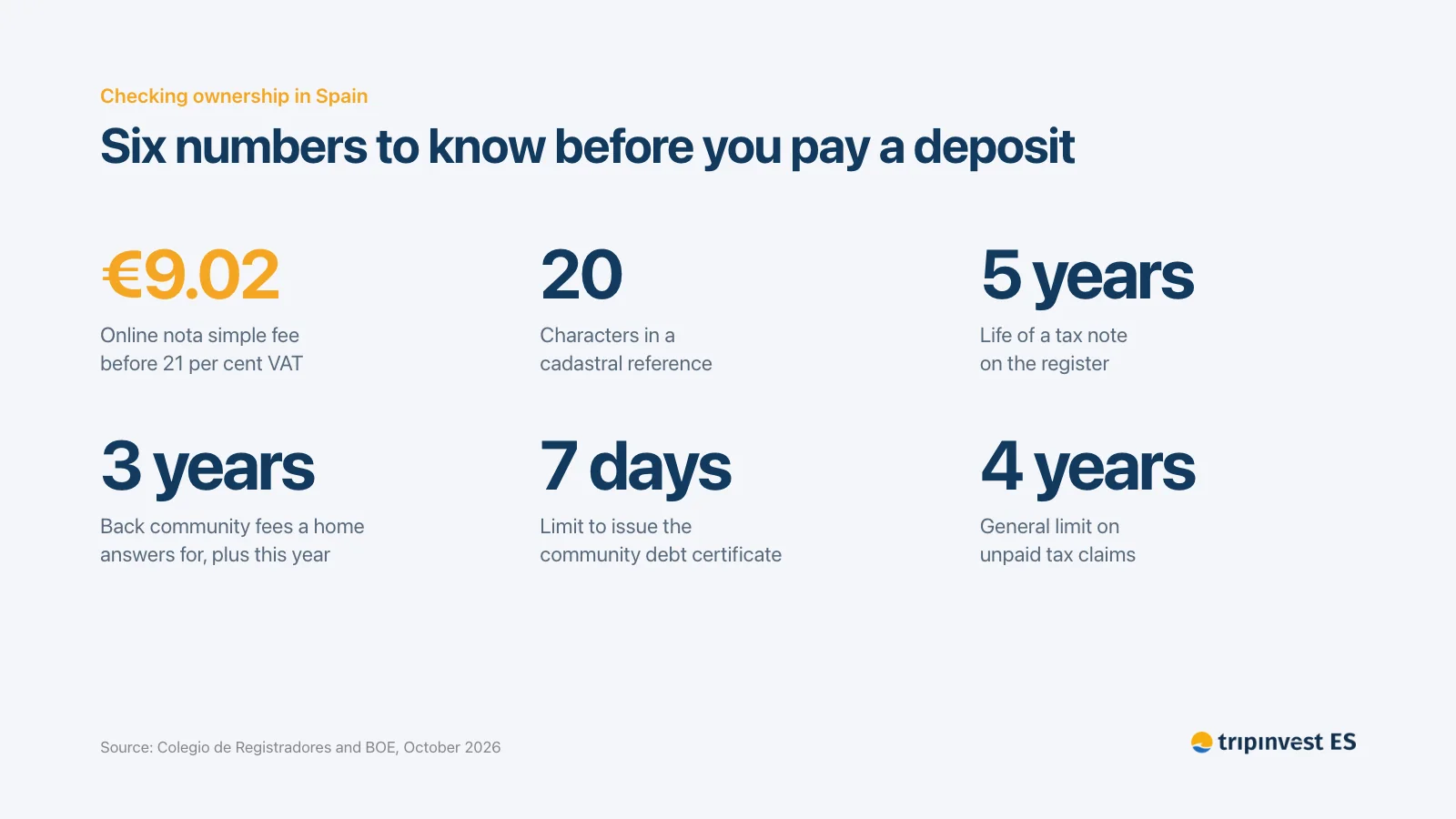
- Pay and wait for the email. The registrars list €9.02 plus 21 per cent VAT per property, or €10.91. Their site says online requests are answered within 24 hours.
Other websites resell the same document for more, so check the address before you pay. The registrars' English service adds a translation for €30, with VAT where it applies. That usually takes three working days and can take up to a week.
How do you read a nota simple?
The registrars publish a sample extract with English notes. These are the parts that matter.
| Part of the extract | Spanish wording | What to check |
|---|---|---|
| Date | Fecha de emisión | A snapshot of that day only |
| Property | Finca, IDUFIR, descripción | Address, floor, area and cadastral reference |
| Building | Propiedad horizontal, cuota | The home is in a community |
| Restrictions | Vivienda de Protección Oficial | Social housing has extra rules on resale |
| Owner | Titularidad, N.I.F. | Name and ID number match the seller |
| Share | Pleno dominio, 100% | Full ownership. Anything less, such as a usufruct, needs explaining |
| Mortgage | Hipoteca | Lender, amount and term |
| Attachment | Embargo, anotación | A court or public body has attached the home over a debt |
| Foreclosure | Certificación de cargas | Can signal that enforcement has begun |
| Tax note | Afección fiscal | A five-year warning about transfer tax, not proof of a debt |
| Pending | Documentos pendientes de despacho | Something is waiting to be registered, perhaps a new sale or loan |
Paying off a loan does not clear the register. A mortgage stays until a cancellation deed is registered, so it can appear even when the seller owes nothing. Your contract should say how it will be cleared by completion.
For spouses who bought together, the entry shows their marital regime, so your lawyer can tell you who has to sign.
What does a nota simple not tell you?
By law, a nota simple is for information only. Only a registry certificate, or certificación, proves charges against third parties, and your lawyer will say if you need one. It also leaves gaps:
- Who lives there. It reproduces registered entries, so a tenant on an unregistered lease or an occupier will not appear.
- Fees and tax. A Spanish government page says it shows whether community fees and property tax are up to date. The registrars' own sample has no such section, so do not rely on it for either.
- What changed afterwards. The registrars warn that the status can change after the extract is issued.
- What was really built. The description can lag behind the building. See our guide on how to check a property in Spain.
Catastro vs land registry: what is the difference?
| Registro de la Propiedad | Catastro | |
|---|---|---|
| Purpose | Legal rights | Physical and tax data |
| Shows the owner's name | Yes | Only to the owner or those with a legal right |
| Shows mortgages and charges | Yes | No |
| Key number | IDUFIR or CRU | 20-character cadastral reference |
| Legal weight | Registered rights presumed correct | Presumed correct, but the Registro prevails on legal points |
The Catastro property search works with a cadastral reference, an address, coordinates or the registry code. Open data needs no login, but the PDF you can print has no legal value.
Then compare the two records:
- Reference. The cadastral reference on the nota simple should match the Catastro.
- Use and size. A missing floor, pool house or extension may mean undeclared work, so ask your lawyer.
- Boundaries. The nota simple says whether the home is coordinated with the Catastro. If it is, the law presumes the plot sits where the map shows. That matters most on villas and rural plots.

ITP on a resale home is charged on the higher of your price and the Catastro's reference value, where one exists, so ask for that figure before you agree a price. Our guide to purchase costs in Spain has the full list.
What does an IBI receipt prove?
IBI is the yearly council property tax. The latest receipt shows that bill was paid, and the law accepts it as evidence of the cadastral reference. It usually shows the cadastral value too, which the public Catastro hides. If the name differs from the nota simple, ask why, as a change of owner may never have reached the Catastro.
Older years matter because unpaid IBI follows the home. The council normally has to pursue the seller first and declare them insolvent. It can then turn to you for years that are not time-barred, generally four. A stronger charge covers the year of the claim and the one before, and needs no insolvency finding.
In most of Alicante province, Suma collects IBI for the town halls, and it has offices in Torrevieja and Calpe. Under an agreement with the notaries' college, the notary handling a sale can get a report of unpaid IBI on any property in the province, except in Alicante city and Jávea (Xàbia). Notaries must also warn you of unpaid IBI in the deed.
That comes late, though. Before a deposit, ask for recent receipts and put in the contract who bears any arrears.
Why do you need a community debt certificate?
If the nota simple shows propiedad horizontal, the home belongs to a community of owners. Under Spanish law, you answer with the home for the previous owner's unpaid fees: the part of the current year already due, plus the three previous calendar years. A registered title does not change that.
The seller must bring a certificate of debts to the notary. The community's secretary signs it, with the president's approval, within seven calendar days of the request. Without it the notary cannot authorise the deed, unless you waive it. Do not waive it.
Ask for it before the deposit too, with recent meeting minutes. A one-off charge that was approved but is not yet due may not appear.

How do you find the owner of a property in Spain?
Order a nota simple for the address. The Catastro will not help, because owner names are protected unless you have the owner's written consent or a right listed in the law.
If you know the person but not the property, the registrars offer a location note, which lists what a person or company has registered in Spain. If you cannot identify the property, try the registrars' geoportal.
What if the seller is not the registered owner?
Stop before you pay anything. There may be an innocent reason, but it has to be fixed first.
| What you find | Possible reason | What to do |
|---|---|---|
| Different name | Unregistered inheritance or sale | Your lawyer traces the title. The Registro will not record a sale from someone else, with narrow exceptions |
| Someone signs for the owner | Power of attorney | Get a copy for your lawyer |
| Several owners, one seller | Co-ownership | All owners must sign or give a power of attorney |
| Embargo or foreclosure note | Unpaid debt | Your lawyer confirms how and when it is cleared |
What is the right order for these checks?
- Ask for the address, cadastral reference and IDUFIR.
- Look up the home on the Catastro.
- Order a fresh nota simple.
- Compare the owner with the seller's passport or ID.
- Ask for recent IBI receipts.
- Ask for the community certificate and minutes.
- View the home and ask who lives there.
- Give it all to your lawyer before you pay a deposit.
- Check again before you sign.
The notary must also check the title and charges at the registry as close to signing as possible, unless you say you are satisfied without it. Do not waive that either.
Do these checks work for off plan homes and auctions?
Not fully. An off plan flat may not be on the register yet, so check that the land is in the developer's name and that the town hall has licensed the build. Our guide to off plan property in Spain covers the stages. At auction, older charges can stay with the home, so read our guide to Spanish property auctions first.
Should you do the checks yourself?
Order the nota simple yourself. For about €11 it can stop a bad purchase early. Then use an independent Spanish lawyer to read it and check the rest. For the wider picture, see buying property in Spain from the UK and our purchase guide.
Frequently asked questions
Is a nota simple proof of ownership?
No, not formally. By law it is for information only and does not certify the entries. It is still the standard first check, because it shows the registered owner and charges on its issue date. For formal proof against third parties, Spanish law requires a registry certificate, which your lawyer can request.
How much does a nota simple cost?
The registrars list €9.02 plus 21 per cent VAT per property, or €10.91, when you order through their portal. Translation into English costs €30 more through their own service, with VAT where it applies. Third-party websites sell the same document for more, so check that you are on the official site.
Can anyone request a nota simple?
Yes, if they have a known interest in the property. Spanish law opens the register to people with that interest, and a planned purchase counts. You state your reason on the request and it is printed on the extract. You can request one from any registrar, whichever district the property is in.
How long is a nota simple valid?
It has no fixed validity. It shows the register on the date of issue, and the position can change the next day. Use a recent one before you pay a deposit. Before you sign the deed, the notary normally checks the registry again, which picks up later changes.
Can I find out who owns a property for free?
Generally not. The Catastro is free, but it hides the owner's name and cadastral value unless you own the property or have a legal right to see them. The registered owner's name comes from a nota simple, which costs about €11 online.
Found a home you want to check?
Talk to us before you pay anything. Send us the link and we will tell you whether the home is worth a viewing. On the homes we handle, we work with lawyers who check the property before you sign, and we keep an eye on the deadlines. We also work with banks, and service is in English from the first call to the notary. Browse homes for sale in Torrevieja, or visit our London office at 8 Royal Parade, no appointment needed, Monday to Friday, 9am to 5pm. Tripinvest ES (TripInvest UK Limited) is a licensed agency, RAICV 4221. Our clients don't pay us commission.
Call us on +44 20 3888 0008.
Sources
Last checked: October 2026
- Colegio de Registradores: the Registro de la Propiedad, nota simple and certificates (official)
- Colegio de Registradores: Land Registry information service in English, prices and translation (official)
- Colegio de Registradores: sample Land Registry extract with guidelines (official)
- Colegio de Registradores: online portal (official)
- Spanish Government: buying real estate, notaries and property registers, updated 30 March 2026 (official)
- BOE: Ley Hipotecaria, articles 9, 10, 20, 34, 38, 82, 221, 222 and 225 (official)
- BOE: Reglamento Notarial, article 175 (official)
- BOE: Real Decreto Legislativo 1/2004 on the Catastro, articles 3, 38, 41, 51, 52 and 53 (official)
- BOE: Real Decreto Legislativo 2/2004 on local taxes, article 64 (official)
- BOE: Real Decreto Legislativo 1/1993 on ITP, articles 5 and 10 (official)
- BOE: Ley 58/2003, General Tax Law, articles 66, 78 and 79 (official)
- BOE: Ley 49/1960 on horizontal property, article 9 (official)
- Dirección General del Catastro: products and free access (official)
- Dirección General del Catastro: help on open data searches (official)
- Sede del Catastro: property search (official)
- Suma Gestión Tributaria: report for notaries on unpaid IBI (official)
- Suma Gestión Tributaria: offices (official)
- Uría Menéndez: IBI, property liability and the tacit legal mortgage, 16 September 2024
- Idealista: when a buyer must take on unpaid IBI, 8 October 2025
- Idealista: registering a mortgage cancellation, 14 March 2026
- Idealista: how to request a nota simple, 11 January 2024