
How to get Spanish residency from the UK: routes compared
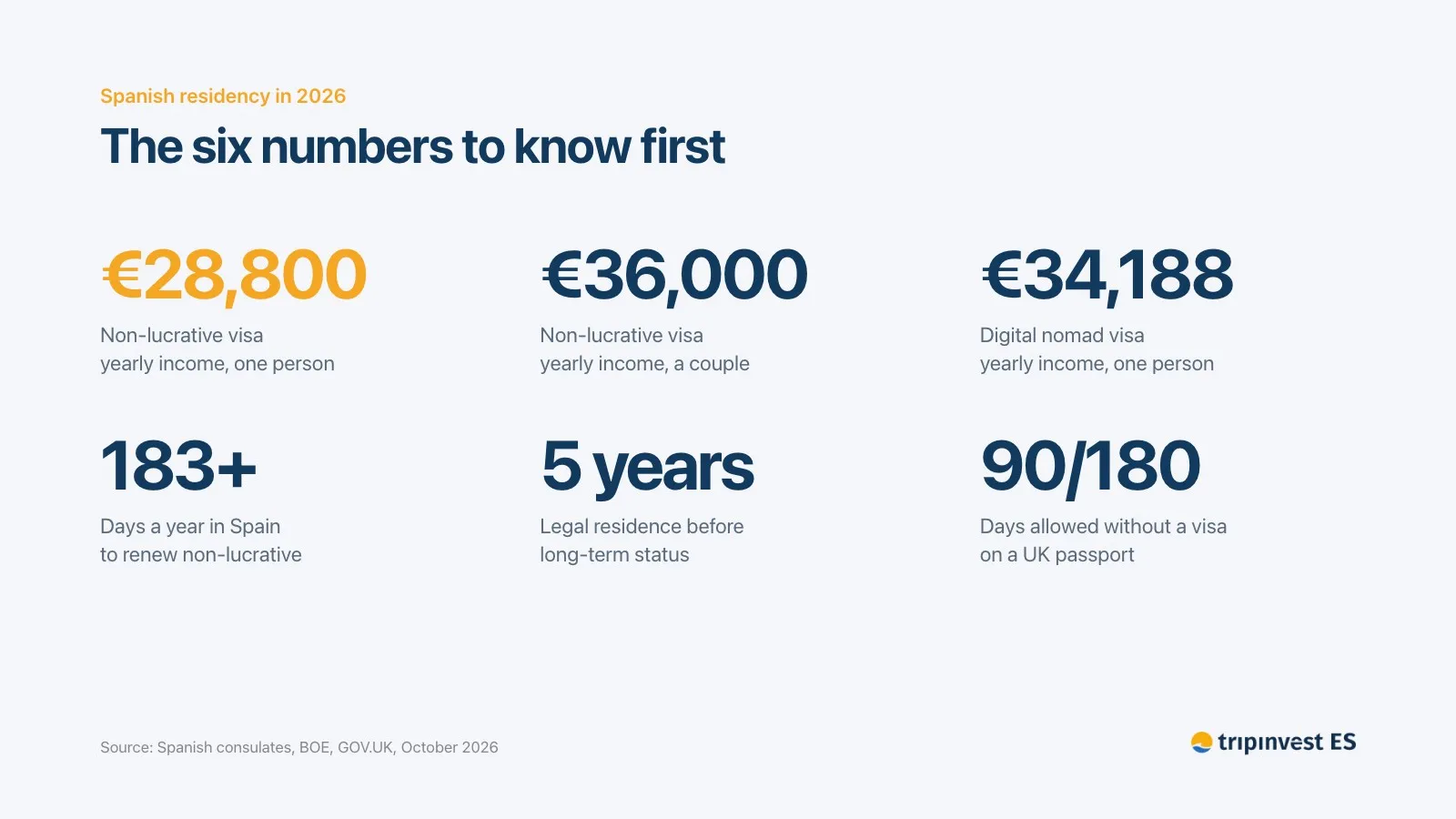
How to get Spanish residency depends on your passport. UK nationals usually need a visa from a Spanish consulate before moving, most often the non-lucrative visa (€28,800 a year) or the digital nomad visa (€34,188). Irish citizens simply register in Spain. Buying a home no longer gives you residency.

Do you actually need Spanish residency?
Not if you stay under 90 days. A UK passport gives you 90 days in any 180 across the whole Schengen area, and time in France or Italy counts too. Owning a home in Spain changes nothing.
Say you land on 1 November 2026 and stay put. Your 90th day is 29 January 2027, and your days only start to free up on 30 April. Overstaying can bring a ban of up to three years. The EU Entry/Exit System has been fully operational since 10 April 2026, so your fingerprints and photo may be recorded instead of a passport stamp. ETIAS, the €20 travel authorisation, has not started yet.
Our post on buying in Spain after Brexit covers owners who remain visitors. The 90-day rule does not apply to Irish citizens.
Which Spanish residency route fits you?
Spain's residency requirements for UK citizens depend on the route. The money column uses 2026 rates: the IPREM income benchmark is €600 a month and the minimum wage is €1,221 over 14 payments.
| Route | Who it suits | Money to show | Can you work? | Where you start |
|---|---|---|---|---|
| Non-lucrative visa | Retirees, people living on pensions or savings | €28,800 a year, plus €7,200 per dependant | No | Consulate, through BLS |
| Digital nomad visa | Remote staff and freelancers with foreign clients | €34,188 a year, plus family add-ons | Yes, for non-Spanish firms | Consulate through BLS, or in Spain |
| Self-employed visa | Trades, freelancers and small firms setting up in Spain | Enough to fund your business plan | Yes | Consulate, through BLS |
| Entrepreneur visa | An innovative project of economic interest to Spain | €600 a month, €900 for two | Yes | UGE unit in Spain, then consulate |
| Work visa | Someone with a Spanish job offer | Set by the job | Yes | Your employer, in Spain |
| EU registration | Irish citizens | No visa. A job, or enough resources and health cover | Yes | Register in Spain |
| Family of an EU citizen | A British spouse of an Irish citizen | Your spouse must qualify | Yes | Family card in Spain |
| Family of a Spanish citizen | A British spouse or registered partner living with them | Proof of the relationship | Yes | Foreigners' office in Spain, or consulate |
If you moved to Spain before 1 January 2021 and have lived there legally since, you have Withdrawal Agreement rights. You need no new visa, but you should hold a TIE residence card.
What do you need for the non-lucrative visa?
Our post on retiring in Spain covers the lifestyle side. The test is 400 per cent of the IPREM for you and 100 per cent for each dependant, met by savings or a regular income.
| Household | Per month | Per year |
|---|---|---|
| One person | €2,400 | €28,800 |
| A couple | €3,000 | €36,000 |
| A couple and one dependent child | €3,600 | €43,200 |
The London consulate's list asks each applicant for:
- The national visa form, form EX-01 and a photo.
- A passport valid for at least a year, with two blank pages, issued within the last 10 years.
- Proof of funds or income. For accounts outside Spain, your 31 December balance and the previous year's average.
- Health insurance from an insurer authorised in Spain, covering all public system risks. A registered S1 is also accepted.
- A criminal record certificate covering five years, under six months old. UK applicants use ACRO.
- A medical certificate dated within three months.
- Proof that you live in the consular district.
- The fee on form 790, code 052. Fees change regularly, so check the consular fee list.
Foreign documents must be apostilled or legalised and, where needed, officially translated into Spanish.
In the UK you apply in person through the BLS visa centre for your consular district: London, Manchester or Edinburgh. The legal decision period is 2 months, longer if the consulate asks for an interview or more documents. You collect the visa within a month, then apply for your TIE card within a month of arriving.
The trap is work. This visa allows no paid or professional activity, so treat remote work for a UK employer as work.
How does the digital nomad visa work?
You need at least 200 per cent of the minimum wage: €2,442 a month over 14 payments, or €34,188 a year (about €2,849 across 12 months). Add about €916 for the first family member and about €305 for each further one.
Your employer or client must have traded for at least a year, and you need at least three months with them, plus a degree or three years of relevant experience. Freelancers can take up to 20 per cent of their work from Spanish firms. You also need health insurance from an insurer authorised in Spain. Applicants staying in the UK system need an A1 form from HMRC.
The legal decision period at the consulate is 10 days and the visa lasts up to a year. You can then apply from Spain for a permit of up to three years, renewable for two at a time. If you are already in Spain legally, for example as a visitor, you can apply for that permit directly. Our post on digital nomads on the Costa del Sol looks at where to base yourself.
What about self-employed, entrepreneur and work visas?
Self-employed. You file the visa and work authorisation together, with a business plan, proof of funds and any licences your trade requires. The legal decision period is 4 months.
Entrepreneur. The project must be innovative or of special economic interest, with a favourable report from the public company ENISA. You get a permit from the Large Companies Unit (UGE) first, then the visa. Each further household member adds €300 a month. The permit runs for three years, then two.
Work visa. Your employer obtains the authorisation first, and you then have a month to apply. The job must normally be on Spain's regional list of hard-to-fill occupations, or your employer must show the post cannot be filled locally.
How do Irish citizens get residency in Spain?
Irish citizens need no visa. To stay beyond three months you must register with the Foreigners' Office or the police, within three months of arriving, and the certificate is issued straight away. You must be working, or have both health cover for all risks and enough resources not to need Spanish social assistance.
A British spouse of an Irish citizen can apply for a family member's card within three months of arriving, as long as the Irish partner qualifies and you move together or join them.
If a grandparent was born in Ireland, you can become an Irish citizen through the Foreign Births Register. It costs €278 for an adult and takes about 12 months.
Can you get residency in Spain by buying a house?
No. Spain removed the Golden Visa from its law with effect from 3 April 2025, so a purchase at any price, including the old €500,000 level, no longer leads to residency. Applications filed before that date were protected.
You can still buy as a non-resident. An NIE is only a foreigner's identification number and gives no right to live here. The income tests do not fall because you own a home, though you will have no rent to pay and an address to register.
Budget up to 13 to 14 per cent on top of the listing price, as our guide to purchase costs explains. Our where to live guide compares towns, or browse homes for sale in Torrevieja.
What do you do after arriving on the Costa Blanca?
- Register on the padrón at your town hall. In Calpe you do this at the citizens' office, Avenida de Ifach 12, with your deed, IBI bill or lease. In Torrevieja the Department of International Residents helps in English, by appointment at La Mata town hall or Plaza de Capdepont.
- Apply for your TIE. The national police directory lists residence cards at Calle Campo de Mirra 6 in Alicante, and foreigner procedures at the Torrevieja, Benidorm and Dénia stations. It lists none in Calpe, so check first.
- Sort out healthcare. UK State Pensioners may qualify for an S1, which you register with the Spanish social security office. A GHIC is not a residency route. Otherwise you stay on private cover, and after a year's residence you can usually join the public Convenio Especial at €60 a month under 65, or €157 from 65. You must be on the padrón when you apply. GOV.UK says a year on the padrón, but Spain's health ministry also counts residence in the UK or EU, so ask which applies. You pay full price for prescriptions.
- Exchange your driving licence. You can drive on a UK licence for up to six months. To keep driving after that you must exchange it, so apply early.

How long does it take to get permanent residency in Spain?
Usually five years. On the non-lucrative visa it runs like this.
| Stage | Length | What to watch |
|---|---|---|
| First permit | 1 year | Your TIE, within a month of arriving |
| First renewal | 2 years | Apply in the two months before expiry |
| Second renewal | 2 years | Same income, insurance and day tests |
| Long-term residence | Indefinite | Five years' continuous legal residence |
| Spanish nationality | After 10 years | Spain does not recognise dual citizenship with the UK |
The rule to plan around is on renewal: Spain's 2024 regulation requires you to have lived in Spain for more than 183 days in the calendar year. A long summer back in Britain is fine, but splitting the year evenly is not.
Long-term residence has its own absence limit: no single trip over six months and no more than 10 months in total across the five years. Once you hold it, you can live and work here indefinitely, though it can lapse after 12 months in a row outside the EU.
What are the downsides of Spanish residency?
- Tax. More than 183 days in a calendar year normally makes you Spanish tax resident for that year, taxed on your worldwide income, so the non-lucrative renewal rule and tax residence usually go together. A UK and Spain double taxation agreement should stop the same income being taxed twice, but take advice before you move.
- Foreign assets. Residents must report overseas accounts, investments or property above €50,000 a category on form 720.
- Little official help. British consulates in Spain cannot help with Spanish visa or residency applications, so budget for a lawyer or gestor.
Frequently asked questions
Can a UK citizen move to Spain without a visa?
No, not for more than 90 days in any 180. You can visit and own property without a visa, but living in Spain requires a visa or residence permit, and most routes start at a consulate before you move. Irish citizens are different: as EU citizens they just register in Spain.
How much money do you need for Spanish residency?
For the non-lucrative visa in 2026, you must show €28,800 a year for one person and €36,000 for a couple. The digital nomad visa needs €34,188 a year for one person, plus family add-ons. Self-employed applicants must instead show enough funds for their business plan.
Can I get Spanish residency by buying a property?
No. Spain ended the Golden Visa for property investors on 3 April 2025, so buying at any price no longer leads to residency. You can still own a Spanish home as a visitor under the 90-day rule, or apply for another visa on its own terms.
Can I work remotely on a non-lucrative visa?
No. The visa is for people who live in Spain without any paid or professional activity, so treat remote work for a UK employer or clients as work. If your income comes from remote work, the digital nomad visa is the right route, and it needs a higher income.
Do Irish citizens need a visa to live in Spain?
No. Irish citizens can live and work in Spain without a visa, but must apply to register within three months of arriving. You need a job, or enough resources and health cover. A British spouse can then apply for a family member's card, which also allows work.
Thinking about a home and a move together?
We help British and Irish buyers find a home on the Costa Blanca and guide you from the first call to the notary, in English. We work with lawyers and banks, and we keep an eye on the deadlines around your purchase. Our clients don't pay us commission. Tripinvest ES is a licensed agency, RAICV 4221. Call us on +44 20 3888 0008 or send us a message.
Sources
Last checked: October 2026
- Spanish Consulate in London: non-lucrative visa
- Spanish Consulate in London: digital nomad visa
- Spanish Consulate in London: self-employed work visa
- Spanish Consulate in London: entrepreneur visa
- Spanish Consulate in London: NIE
- Spanish Consulate in London: requirements for investors and entrepreneurs
- Spanish Consulate in London: residence and work visa checklist
- Spanish Consulate in Manchester: non-lucrative visa
- Spanish Consulate in Edinburgh: non-lucrative visa
- Spanish Consulate in Washington: IPREM figures for 2026
- BOE: Real Decreto 1155/2024, immigration regulation
- BOE: Real Decreto 240/2007, EU citizens and their families
- BOE: Ley 14/2013, entrepreneurs, remote workers and investors
- BOE: Ley Orgánica 1/2025, end of the investor visa
- BOE: Ley 35/2006, income tax
- BOE: Real Decreto 1065/2007, overseas asset reporting
- BOE: Código Civil, nationality by residence
- Agencia Tributaria: tax residence
- Agencia Tributaria: form 720 limits
- Ministerio de Sanidad: Convenio Especial
- Spain's national police: office directory
- GOV.UK: living in Spain
- GOV.UK: healthcare in Spain
- GOV.UK: Spain entry requirements
- European Commission: Entry/Exit System
- Ireland Department of Foreign Affairs: Foreign Birth Registration
- Ayuntamiento de Torrevieja: Department of International Residents
- Ayuntamiento de Calp: padrón registration
- OCU: minimum wage and IPREM in 2026